Cyperus esculentus
Family: Cyperaceae
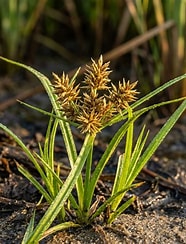
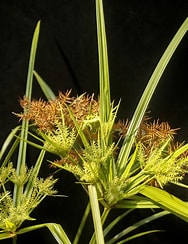
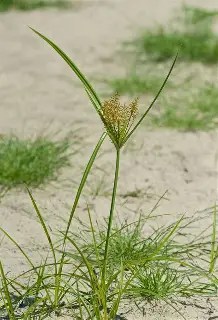
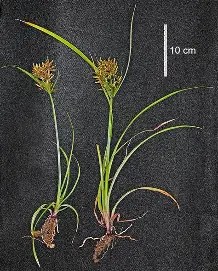
Description: Perennial to 50 cm high, forming colonies by creeping rhizomes with solitary stems growing from a tuber. Leaves 3-9 mm wide. Spikelets 1-3 cm long. The spikelets of the plant are distinctive, with a cluster of flat, oval seeds surrounded by four hanging, leaf-like bracts positioned 90 degrees from each other. They are 5 to 30 mm (0.25 to 1.12 in) long and linear to narrowly elliptic with pointed tips and 8 to 35 florets. The color varies from straw-colored to gold-brown. The roots are an extensive and complex system of fine, fibrous roots and scaly rhizomes with small, hard, spherical tubers and basal bulbs attached. Bulbs look like small garlic cloves.
Location: Frequent in ditches, fields, stream bottoms, and swales and on island dunes. It is found in most of the Eastern Hemisphere, including Southern Europe, Africa and Madagascar, as well as the Middle east and the Indian Subcontinent.
Soil Type: Sand and sometimes clay
Trivia: The plant is reproduced by seeds, creeping rhizomes, and tubers. One plant can produce several hundred to several thousand tubers during a single growing season. They can produce up to 2420 seeds per plant. Was one of the oldest cultivated plants in prehistoric and Ancient Egypt, where it was an important food.
Bloom: Apr-Dec
Importance: Cultivated in many countries. are used primarily as animal feed or as a side dish, but in Hispanic countries they are used mainly to make horchata, a sweet, milk-like beverage. Dried tiger nut has a smooth, tender, sweet, and nutty taste. It can be consumed raw, roasted, dried, baked or as tiger nut milk or tiger nut drink or oil.
 stxflora