Lepidium virginicum
Family: Brassicaceae
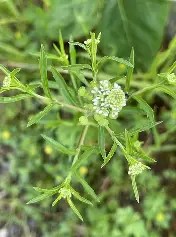


Description: Annual to 60 cm high with entire to toothed or pinnatifid leaves 1-15 cm long, are sessile linear to lanceolate and get larger as they approach the base. Flowers in racemes, the white petals 1-3 mm long. rows from a single stem, branched in the upper third, sparsely hairy. Lower leaves are lance-shaped, sharp-toothed, and deeply divided. Tiny flowers grow in dense clusters. The fruit is a long, narrow pod (silicle), green turning brownish.
Field Identification: The most identifiable characteristic is its raceme, which comes from the plant’s highly branched stem. The racemes give it the appearance of a bottlebrush. Racemes var small white flowers which develop into flattened seed pods.
Plant Trivia:
Occurrence: Common on various soils in prairies, openings, fields, and waste places and along beaches. It is native to much of North America, including most of the United States and Mexico and southern regions of Canada, as well as most of Central America.
Bloom Period: Feb-May
Plant Use: Leaves and seeds can be eaten in salads and seeds ss pepper. Leaves contain Vitamins A and C and protein. Larval host: Lygus lineolaris and Pseudatomoscelis seriatus, Heriades leavitti, Pieris butterflies and noctuid moths, aphids, beetles, and grasshoppers.
Dichotomous Key: A key to the Genus Lepidium may be found in Plants of the Texas Coastal Bend by Roy L. Lehman, Ruth O’Brien & Tammy White.