Schoenoplectus pungens longispicatus
Family: Cyperaceae
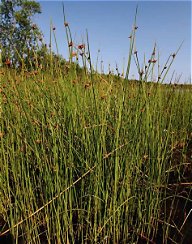
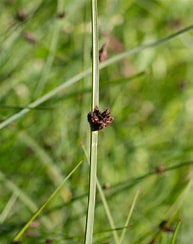
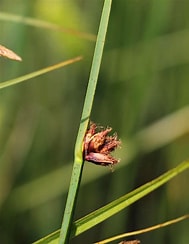
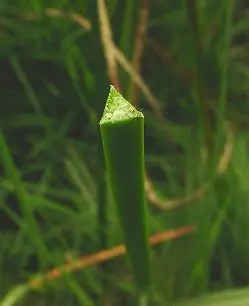
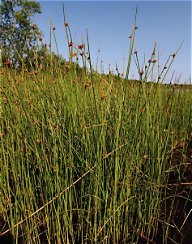
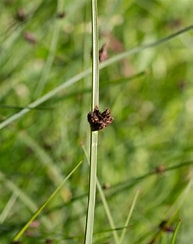
Description: Herbaceous, rhizomatous perennial with stems to d1 m or higher, forming colonies. Leaves 2-4 mm wide. Spikelets 1-7 per cluster. l has upright, triangular, and rarely concave stems. The stems are erect to strongly arched and 1.5-10 dm in height and 2-6 mm wide in the middle. The narrow (2-4 mm) wide, grasslike, basal leaves are all in the lower third of the stem. Leaves are flat to slightly rounded near the base and become more cylindric toward the tip. The inflorescences are lateral clusters of 1-7 sessile spikelets subtended by an involucral bract that appears to be a continuation of the stem. The scales are yellowish to reddish brown. Fruits are small, brown, lenticular achenes
Location: Frequent in low fresh or brackish sands along shores and banks or in depressions, swales, and ditches. Native to Central United States and Canada westward.
Soil Type: Sand, mud
Trivia:
Bloom: Apr-Dec.
Importance: The soft, spongy stems of basket grass were traditionally used and are still used for basketweaving; the triangular stems are commonly used for the bottom and ‘ribs’ of the round, wrapped, and twined “grass” baskets made by first people of the west coast of Canada and Washington. The pithy, cylindrical stalks were used to weave matting, as well as for bedding and roofing material. As thatching material, basket grass was spread out in bundles, tied together, then secured in place with poles. Basket grass or common threesquare is especially good for stabilizing or restoring disturbed or degraded areas, for erosion and slope control, and for wildlife food and cover.
The seeds, being less hairy and larger than cattail, are the choice food for wetland birds: baldpate, bufflehead, mallard, pintail, shoveler, blue winged teal, cinnamon teal, greater scaup, lesser scaup, avocet, marbled godwit, clapper rail, Virginia rail, sora rail, long-billed dowitcher, and tricolored blackbird The stems provide nesting habitat for blackbirds and marsh wrens.

