Convolvulus equitans
Family: Convolvulaceae
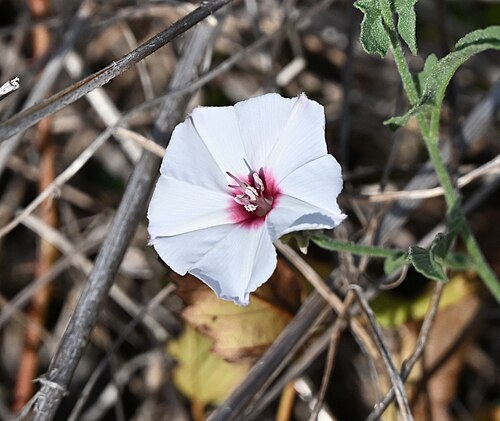
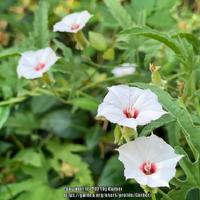
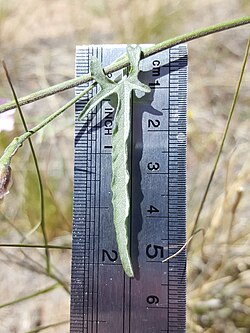
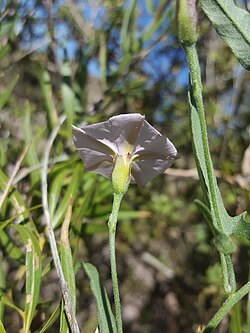
Plant Description: Annual or Perennial vine with trailing or twining stems to 2 m or longer. Leaves mostly 2-6 cm long, blades hairy, arrowhead shaped, entire to variously toothed or lobed, grayish, alternate. Flowers solitary, funnel shaped, white t pink is often with red centers, the corolla 1-3.5 cm long, white or lavender, of ten red in throat, petals fused together.
Field Identification: Twining vine or low-growing ground cover, 0.3–1.8 m (1–6 ft) tall depending on variety and conditions. Leaves alternate, ovate to lanceolate, 1–3 inches long, toothed margins, often with arrowhead-like basal lobes; surfaces densely covered in matted hairs. Flowers Funnel-shaped, 20–38 mm wide, white to pink with a deep pink midstripe; sepals hairy, bracts scale-like; bloom from spring through fall.
Plant Trivia: Convolvulus (from Latin convolvere, “to roll together”); equitans (Latin for “riding on horseback”), likely referencing its ability to thrive in robust, challenging environments. Ours may be Convolvulus e. equitans, Beach Bindweed.
Occurrence: Frequent in openings, prairies, and waste places, usually on loamy soils or caliche, but usually growing in sandy soils. Northern Mexico and South west region of US.
Bloom Period: Spring – Summer
Plant Use: White taileded deer and Bobwhite Quail feed on seeds. Ground cover in dune and rocky areas; stabilizes soil; provides food for pollinators and wildlife. Larval host for the painted crescent butterfly; eaten by white-tailed deer and bobwhite quail; seeds consumed by birds
Key to the Genus Convolvulus:
- Calyx 3-5 mm long…………………………………………….C. arvensis
Calyx 6-12 mm long………………………………………….C. equitans

