Aristolochia erecta
Family Astrolochiaceae
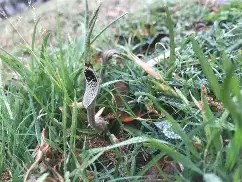
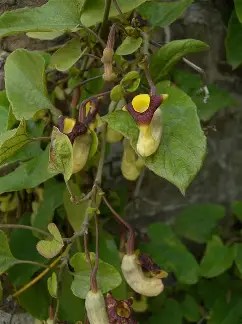
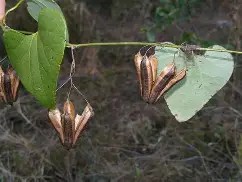

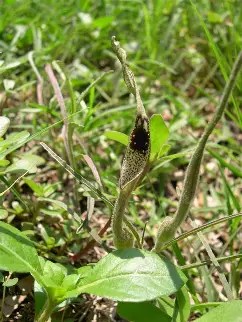
Description: Perennial with ascending or spreading stems 6-30 cm long. Leaves mostly linear or oblong, 2-12 cm long. Flowers solitary. Corolla 5-11 cm long, tubular below, the expanded upper part dark colored with yellow or greenish spots.
Field Identification: Native vine that grows best mixed with short grasses. In fact, its leaves have evolved to mimic grass which is why it’s often hard to spot. This is a miniature version of Giant Astrolochia.
Plant Trivia: Swanflower is a trailing grass mimic, presumably to evade female Pipevine swallowtail butterflies looking for a good place to lay their eggs. The caterpillars are black or orange and fleshy, often easier to spot than their host plants. Swanflower, like all Astrolochia species, has an interesting tubular shaped flowers that look like small orchids. One of the easiest is to notice the butterfly that uses swanflower as a larval host plant, the Pipevine Swallowtail Butterfly. Adults are large and black with colorful spots and iridescence. If you see one hovering around a patch of grass, it’s likely homing in on swanflower. It is a member of the pipevine family, so named because most of the members have inconspicuous flowers shaped like Sherlock Holmes’ pipe. Not so with swanflower, which produces a rather large tubular flower with a black and white throat that stands upright. The specific epithet “erecta” is a nod to this unique feature. If you plant it, don’t be surprised when hungry caterpillars eat the plant flowers and all to the ground. This will happen two to three time a year and swanflower will grow back every time.
Plant Use: Food source for the Pipevine Swallowtail Butterfly
Occurrence: Frequent on sandy soil in openings and prairies or at the edge of brush. Northeast coastal areas of Mexico and Texas coastal regions.
Bloom Period: Apr-Oct
Plant Use: Plays a crucial role in stabilizing soil in wetland areas. Its root system helps prevent erosion. Deer, rabbits, squirrels, and rodents are known to eat on these plants.
Propagation: From seeds, plant them at a depth of 1/4 inch. Under optimal conditions, you can expect germination in about 14 to 21 days.

