Iva annua
Family: Asteraceae

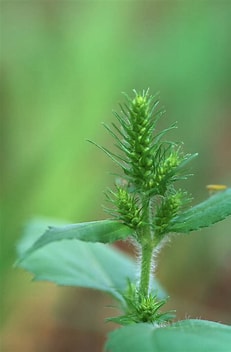
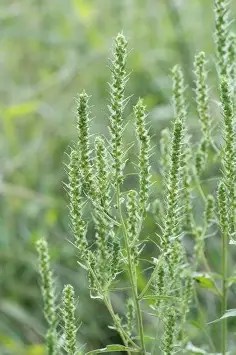


Description: Annual to 120 cm high with ovate leaves 4-10 cm long. Heads 4-5 cm high, each subtended by a leafy bact. Herbaceous. The leaves are opposite on the lower stem and may become alternate near the top, egg-shaped to broadly ovate, and covered with coarse hairs that give a sandpaper-like texture. The plant produces small greenish-white flowers in elongated spike-like arrays, each head containing 11–17 disc florets but no ray florets
Field Identification: Erect plat with all parts green. Inflorescence a terminal spike or multiple spikes. Tends to grow in large clusters. There are multiple species of similar sumpweeds. (See Key below)
Plant Trivia: This species was cultivated by Native Americans around 4,000 years ago. The seeds were highly nutritious, containing 32% protein and 45% oil, making them an important food source before maize became widespread. Cultivated varieties, such as Iva annua var. macrocarpa, had larger seeds (6–9 mm) compared to wild types (3–4.5 mm). The plant was especially significant to the Kansas City Hopewell culture in present-day Missouri and Illinois. Despite its nutritional value, it was eventually abandoned due to its strong odor and allergenic properties, like ragweed.
Occurrence: Frequent on various soils in swales, ditches, and other lower or damp grounds. Native to northeastern Mexico and the central and southern United States.
Bloom Period: Aug-Dec
Plant Use: This species is a North American annual herb historically cultivated for its nutrient-rich seeds. can serve as a host for certain parasitic plants, such as Cuscuta attenuata in Oklahoma and Texas. Its presence in wetlands and disturbed areas contributes to biodiversity and soil stabilization, and it can be used in native plant restoration efforts. Iva annua is an example of a historically important North American crop with both ecological and cultural significance, valued for its seeds and resilience in challenging environments. Birds eat seeds.
Dichotomous Key to the Genus Iva:
- Leaves fleshy…………………………………………I. imbricata
Leaves not fleshy………………………………………….…..………2
2. Leaves entire or nearly so……………………….…I. texensis
Leaves toothed…………………………………..…..………………..3
3. Plant a subshrub………………………….…………I. frutescens
Plant an annual herb……………………….……………I. annua

