Triodanis perfoliate
Family: Campanulaceae

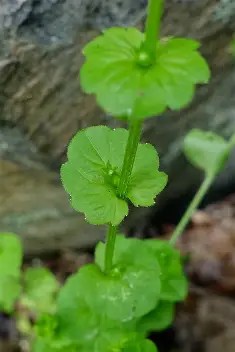
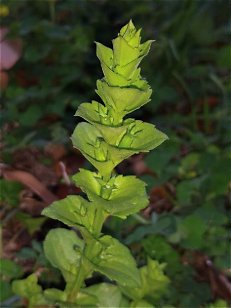
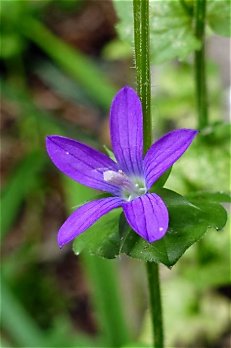
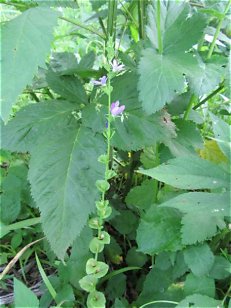
Description: Annual to 50 cm high with mostly ovate leaves 1-3 cm long. Flowers axillary, those of the lower axils all cleistogamous (flowers that self-fertilize without an opening), of the upper axils with well develops purple-violet corollas 8- 12 mm long. Capsules with pore near summit. Petaliferous flowers.
Field Identification: Has a central, unbranched, sparsely hairy stemmed featuring alternate leaves that clasp the stem. The leaves are light green, rounded, up to 2.5 centimetres (1 in) long, and are scallop-edged and shell-shaped. Both the stem and the leaves contain a milky sap. On the upper part of the stem, 1-3 flowers emerge from the leaf axils, although only 1 of these flowers will be blooming at any one time. These flowers are wheel-shaped or bell-shaped, violet blue (rarely white), and approximately 1.3 centimetres (.5 in) across. They have 5-lobed corollas and are radially symmetrical. There are flowers on the lower part of the stem, but they do not open, although they do produce seed.
Plant Trivia: Additionally, we have T. biflora perfoliate. Leaves ovate to elliptic or oblong. Flowers of the axis are usually all cleistogamous, the terminal one usually with well developed purple-violet corolla 5-9 mm long. Capsules with pore near middle. Petaliferous flowers. Blooms Mar-May. Same habitat as above. The genus name, from the Greek treis (three) and odous (tooth), alludes to the three lobes of the calyx in many of the non-opening flowers.
Occurrence: Frequent on various soils, especially sands, in prairies, openings, and waste places and along roads. North and South America.
Bloom Period: Mar-Apr
Plant Use: This plant attracts a variety of bees, flies, butterflies, and moths. The Meskwaki use it as an emetic to make one “sick all day long”, and smoke it at ceremonies.
 stxflora