Justicaia brandegeana
Family: Acanthaceae

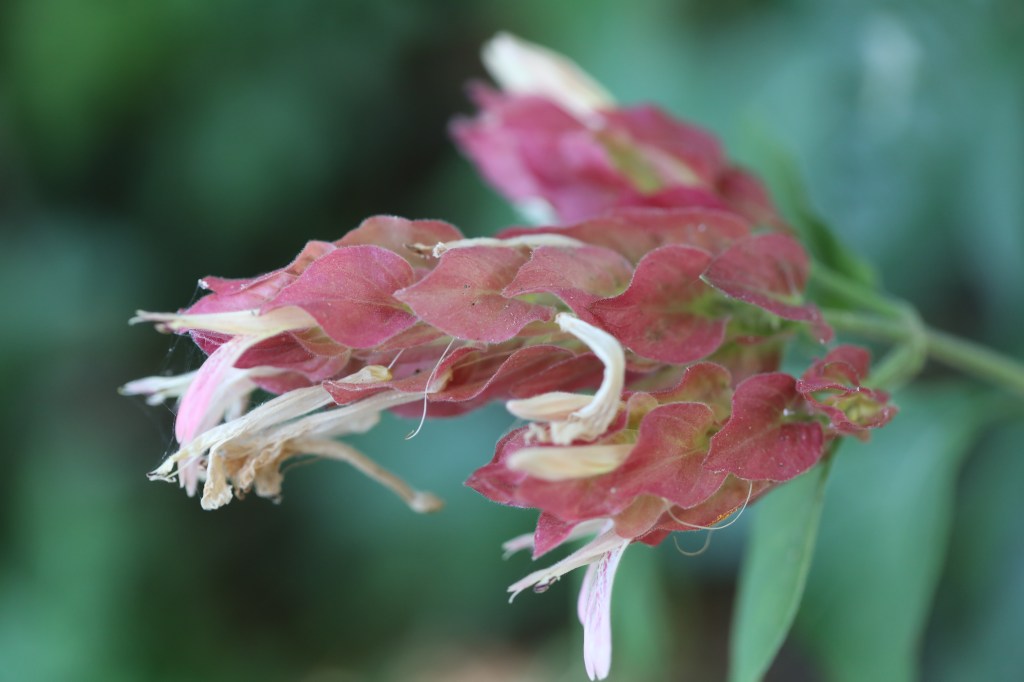


Plant Description: This is a bushy evergreen shrub growing to 100 cm (39 in) tall by 60–90 cm (24–35 in) broad. The stems and leaves are downy. The leaves are variegated and usually grow in clusters on the branches. As the plant receives more sun, the amount of creamy white on the speckled leaves will increase, and vice versa. The flowers emerge from bracts that form off the stems. The bracts start out white, but with more sun exposure they turn anywhere from pale pink to deep salmon. A chain of bracts will continue to grow until it falls off in most cases; thus the chains can grow anywhere from a few centimetres to nearly 30 cm (1 ft) in length. Flowers emerge from the bracts; usually they are long, thin, and white with speckled maroon throats.
Field Identification: It grows to 1 m tall (rarely more) with spindly limbs. The leaves are oval, green, 3–7.5 cm long. The flowers are white, extending from red bracts which look somewhat like shrimps, hence the common name “shrimp flower”.
Plant Trivia: The shrimp plant most of us are accustomed to seeing is a cultivar. The Texas Shrimp Plant, Yeatesia platystegia, is native to Texas; however, it does not grow in our area. Genus name honors James Justice, 18th Century Scottish horticulturist (1698-1763). The Specific epithet is named for the American botanist Townshend Stith Brandegee (1843–1925). It is sometimes misspelled “brandegeana“.
Occurrence: Native to Mexico and naturalized in parts of the Americas. Localized to gardens and landscaping.
Bloom Period: Year-round. Blooming continues for months once it has begun, then halts for a short period before starting again.
Plant Use: Pollination by hummingbirds, but both hummers and butterrflie sare attracted to the flowers. It can be propagated by stem cuttings.
 stxflora