Halodule wrightii (Syn Halodule beaudettei)
Family: Cymodoceaceae
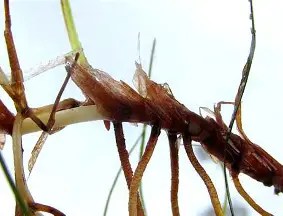


Description: Submerged seagrass; rhizome (long, usually horizontal stem from which stalks and leaves arise) horizontal, underground, white in color; leaves arise from short stalks attached to the rhizome, 2-4 leaves per node; leaves flat, very narrow, up to 2 mm in width, tips (when not broken off) with 3 points (1 long, wide point in the center, 2 smaller points laterally); length of leaves from 5 cm (2 in) to 40 cm (16 in) depending on water depth; leaves sheathed at the base; flowers are rare, small and insignificant, form at the base of the stems; 2 roots extend from the each node of the rhizome.
Field Identification: Submersed perennial from a creeping rootstock. Leaves flattened, about 1 mm wide, 7 -40 cm long dark reddish-brown, with a few teeth on the margins. Flowers axillary, unisexual with sexes on separate plantes. Fruits globose, 2 mm wide, rarely seen.
Plant Trivia: This plant was named after Charles Wright, who was an American botanist and collector. In 1853 and 1856 Wright participated in a surveying expedition and discovered Halodule wrightii. This species of plant has the ability to adapt to various levels of salinity and temperatures.
Occurrence: Common in bay and lagoon waters, forming extensive colonies. Found around the coast waters of the Gulf of Mexico and around the Caribbean.
Bloom Period:
Plant Use: Impact seabeds and increase habitat stabilization through constant shoot and rhizome production. The string-like structure of the seagrass decrease water turbidiy and movement of substrate whether it is sand or mud. Seagrass beds function as an incubator for young juvenile fishes. They provide shelter from predators and reduce competition with other species. hey provide shelter from predators and reduce competition with other species. Halodule wrightii also supplies food resources to several species of fish, invertebrate marine life and manatees.
Dichotomous Key: This is the only species of Halodule in our area.