Paspalum vaginatum
Family: Poaceae
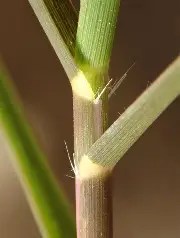


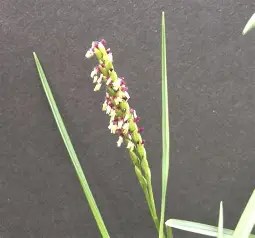
Description: Perennial with rhizomes and/or stolons. Erect portions of culms to 65 cm. Ligules 1-2 mm long, membranous. Panicles terminal, branches paired, a third sometimes below. The leaf blades are 10 to 19 cm (3.9 to 7.5 in) long and may be hairless to slightly hairy. They are usually blue-green in color. The panicle is usually a pair of branches up to 7.9 cm (3.1 in) long; there is sometimes a third branch below the pair. The branches are lined with oval to lance-shaped spikelets which grow pressed against the branches, making the panicle narrow.
Location: Found in coastal regions in brackish and salt marshes. It is native to the Americas, where it grows in tropical and subtropical regions
Soil Type: Moist soil along coast.
Trivia: Far for livestock and wildlife. Truist Park, the home ballpark of the Atlantic Braves, has Seashore Paspalum Platinum TE (a cultivar) as its field surface.
Bloom: May-Oct
Importance: It is cultivated as a turfgrass in many places. This grass has been bred into cultivars which are used for golf course turf and other landscaping projects. It forms a higher quality turf than bermudagrass in poor conditions. other uses for the grass, including erosion control in sandy coastal areas, its native habitat. It can be used in phytoremediation when the soils are high in heavy metals. It has been shown to survive pollution with crude oil It can be used to feed livestock, and some wild herbivores will graze it.

