Solidago sempervirens
Family: Asteraceae
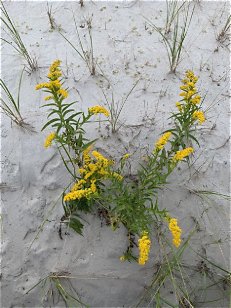
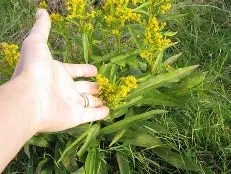
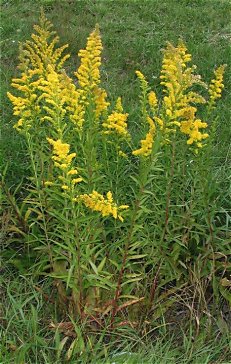
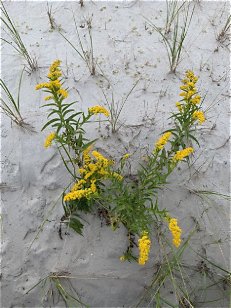
Description: Perennial to 2 m high with thickish narrow leaves 2-25 cm long. Heads in slender or pyramidal panicles, 4-5 wide. Disks and rays yellow. The leaves are fleshy, somewhat succulent, dark green, oblong, and lance-shaped. They are arranged alternately along the entire length of the stem. The leaves at the base are the largest, up to 20 cm long and 1- 4 cm wide, gradually decreasing in size towards the top of the plant.
Field Identification: This perennial produces a tight clump of narrow, evergreen basal leaves topped by leafy, erect or arching, 2 meter stalks. The terminal or upper axillary flowering heads are dense, the lowest branches somewhat recurved. Flowers are deep-yellow and the leaves are somewhat succulent. Succulent-leaved salt-marsh Goldenrod with arching branches that bear one-sided clusters of large, bright yellow flower heads. Flowers are larger than those of other goldenrod species. In winter, the plant’s persistence, whitened leaves, coarse stalks, and dried flower parts make it easily identifiable. Red leaves sprout in late February and early March, and soon become dark green.
Plant Trivia: Stands of seaside goldenrod colonize blowouts, grasslands, and transition areas. Seaside goldenrods often occur with other native dune plants such as coastal panicgrass (Panicum amarum), switchgrass (Panicum virgatum), and salt marsh cordgrass (Spartina patens). Seaside goldenrod is well adapted to coastal habitats including the backside of primary dunes, low secondary dunes, and edges of salt marshes. It has some tolerance for drought, allowing it to survive in the dry conditions of the dunes. Seaside goldenrod is also tolerant of high salinity, salt spray, and fire.
Occurrence: Frequent along coastal swales. Seaside goldenrod mainly grows east of the Mississippi. It grows in the northeast from Canada and the Great Lakes region, south along the Mid-Atlantic coast to Florida, and as far west as Texas.
Bloom Period: Sept-Nov
Plant Use: The flowers are an important food/energy source for fall migrating monarch butterflies traveling the Atlantic coastal flyway. Like many Solidago spp., seaside goldenrod is an important resource for over-wintering, gall producing insects. Some of these insects are predatory wasps that are beneficial to have near crops. In addition, gall larvae provide an excellent source of nutrition in the winter for birds such as the chickadee or woodpecker. It increases the value of wildlife habitat by providing food and shelter for butterflies, birds, and small mammals.
Dichotomous Key to the Genus Solidago:
-
Lower and middle leaves mostly toothed…………………….…2
Lower and middle leaves entire……………………………….……..3
-
Stems and leaves covered with fine hair…. S. canadensis

