Eleocharis montevidensis
Family: Cyperaceae
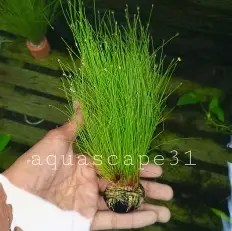
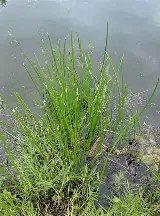
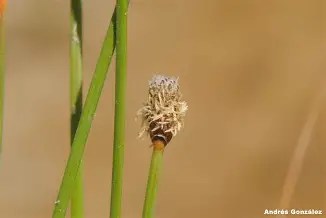
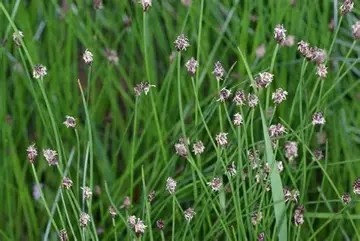
Description: Rhizomatous perennial to 50 cm high, forming colonies. Spikelets 4-13 mm long. Achenes are about 1 mm long. Forms tufts or mats of erect, firm stems up to half a meter tall. The narrow grasslike leaves are dark purplish or reddish brown at the bases, becoming lighter in color toward the tips, and drying to a thin, papery texture. The inflorescence is an oval-shaped spikelet appearing at the tip of the stem. It is under a centimeter long and made up of several flowers covered in brownish bracts. Hairlike leaves of this spikerush are seen almost anywhere there are low-lying wet areas in full sun. Growing in dense mats, it can cover many meters with its delicate foliage and dainty, cone-like flowerheads. The leaves are thin and hair-like, giving it a fine texture, and the flower spikes resemble small cones. They are green on the upper parts and red or purple at the base. The leaves are simple, linear, and arranged alternately along the stem. They have entire margins and are not hairy, which contributes to their smooth and slender look.
Location: Frequent fresh or brackish depressions, swales, and ditches or on pond, lake, and stream margins. Native to the Americas
Soil Type: Moist sand.
Trivia: Propagation by root division. Serves as a host plant for the Yellow-Collared Scape Moth and Thopeulis forbesellus. It is flood-tolerant, thrives in both acidic and alkaline soil, and can withstand occasional droughts.
Bloom: Mar-Nov
Importance: Sometimes cultivated as a pond plant for water gardens. All parts are eaten by many species of waterfowl and shore birds. Good as a lawn replacement for low, wet areas.

