Tamarix spp.
Family: Tamaricaceae

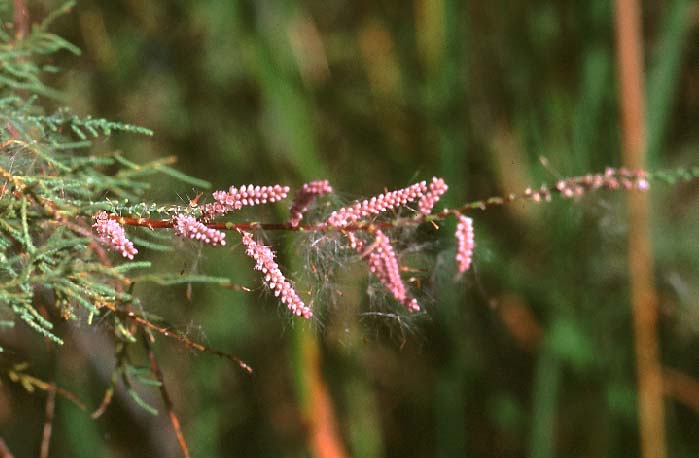
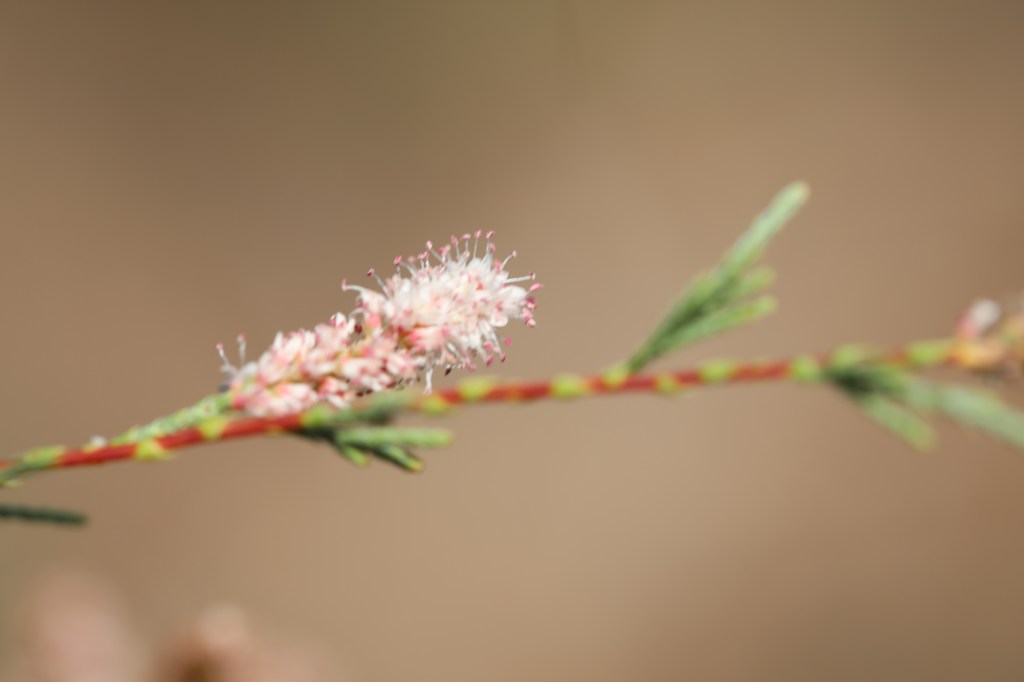
Plant Description: Shrub or tree, 5-20 ft. tall, with tiny leaves composed of scales scarcely more than 1 mm long. Flowers are small, pale pink to white, perfect and regular, arranged in highly visible spike-like racemes, the stamens appear on a fleshy, lobed disk.
Plant Trivia: Invasive genus. As the name implies, salt cedar adaptations include storing salt in leaves, dropping them to ground which makes the soil below the plant salty and therefore reduces competition by other plants for water and nutrients. Not effective in halophytic soil conditions since all plants are salt tolerant. Out-competes other plants (long tap root, water hog) that can dry up/take over rivers and streams it grows in. Salt Cedar is on the Texas Dept. of Agriculture’s list of Invasive Plants which are illegal to sell, distribute or import into Texas.
Field Identification:
Occurrence: Found throughout the west to Mississippi. Originally planted as a Dust Bowl plant for soil conservation. All species are non-native and come from N. Africa, S Asia, Mediterranean, Canary Islands, China and Japan, Southern Europe, Russia.
Bloom Period: Varies with species.
Plant Use: Wind break.
Key to the species of Tamarix:
- Leaves sheathing the stem……………………………………………T. aphylla
Leaves sessile, not sheathing………………………………………………………2
2. Filaments inserted between the lobes of disk………………………….….3
Filaments not inserted as above………………………………..………………..4
3. Sepals finely toothed; petals obovate……………….T. rumosissimus
.Sepals more or less entire; petals obovate to ellipse.T. chinensis
4. Sepals finely toothed; rachis of raceme papillate.T. canariensis
Sepals entire or subentire raceme rachis smooth…………..T. gallica

