Eragrostis segundiflora oxylepis
Family: Poaceae

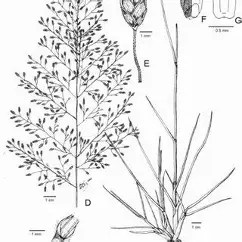


Description: Cespitose tufted perennial without rhizomes. Florets fall intact before the glumes. Red lovegrass panicles are usually contracted, but sometimes open ranging from 5-30 cm long and 1-45 cm wide. The spikelets are in dense clusters on branches and branchlets. Spikelets are pedicellate, linear-oblong to ovate, strongly compressed with 10-26 florets, laterally flattened, pale green or violate to reddish in color.
Location: found in sandy areas, dunes, beaches, grasslands, and disturbed sites. Is native to North America and grows in the southern US and into northern Mexico. Caryopses are dark red to brown.
Soil Type: Mostly sandy soils.
Trivia: This plant may become weedy or invasive in some regions or habitats and may displace desirable vegetation if not properly managed.
Bloom: May-Oct
Importance: Is recommended for use in range seeding mixtures, upland wildlife plantings, roadside plantings, and conservation plantings. Red lovegrass is an early successional plant well adapted to colonizing openings.

