Salix nigra
Family: Salicaceae
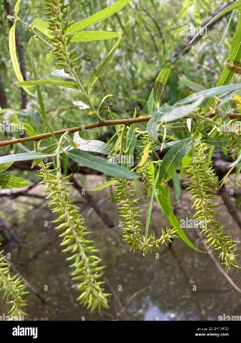
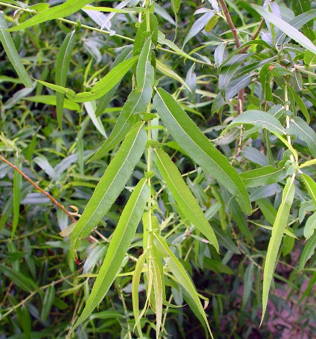
Description: Deciduous tree to 10 meter or higher with simple, linear-lanceolate leaves 4-10 m long, and alternate finely toothed margins. Flowers in yellow catkins appearing with leaves, unisexual with male and female on separate trees. Usually multi-trunked trees.
Field Identification: The bark of black willow is dark brown to black, developing deep grooves and a rough texture with shaggy scales. Lanceolate leaves to 23-23 mm wide. Leaves 10-2 teeth per cm. Large tree with non-drooping branches
Plant Trivia:
Occurrence: Known not only along streams but in damp soils throughout the area. Found in eastern 2/3 of Texas. Alluvial soils along steams and near bodies of water throughout and includes Rio Grande Plains and southern Coastal Prairie, including the barrier islands.
Bloom Period: March-April
Plant Use: White-tailed deer occasionally brows the leaves. Several species of birds use this tree for nesting sites. The wood is soft and weak but is used for building crates, the cores of furniture, wooden utensils, and formerly used for building prosthetics. This is an excellent plant for a pollinator garden, as it serves as larval host for several butterflies including the Eastern Tiger Swallowtail (Papilio glaucus), Mourning cloak (Nymphalis antiopa), Red spotted purple (Limenitis arthemis astyanax), and the Eastern comma (Polygonia comma).
The bark is anodyne, anti-inflammatory, antiperiodic, antiseptic, astringent, diaphoretic, diuretic, febrifuge, hypnotic, sedative, tonic. It has been used in the treatment of gonorrhea, ovarian pains, and nocturnal emissions. The bark of this species is used interchangeably with Salix alba. It is taken internally in the treatment of rheumatism, arthritis, gout, inflammatory stages of auto-immune diseases, diarrhea, dysentery, feverish illnesses, neuralgia and headache. The bark can be used as a poultice on cuts, wounds, sprains, bruises, swellings etc. The bark is removed during the summer and dried for later use. The leaves are used internally in the treatment of minor feverish illnesses and colic. The leaves can be harvested throughout the growing season and are used fresh or dried. The fresh bark contains salicin, which probably decomposes into salicylic acid (closely related to aspirin) in the human body.
Serves as a food and shelter source for various animals. White-tailed deer, rabbits, rodents, and beavers consume its bark, twigs, and leaves. Bees, butterflies, and other insects feed on its nectar. The tree provides shelter for woodland creatures like birds and small mammals, particularly raccoons and woodpeckers, which also feed on its fruit.
Dichotomous Keyto Genus Salix:
- Leaves mostly about 2 mn wide………………………...S. interior
Leaves mostly 6-9 mm wide…………………………………S. nigra
 stxflora