Chenopodium berlandieri
Family: Chenopodiaceae

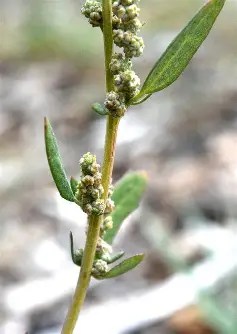
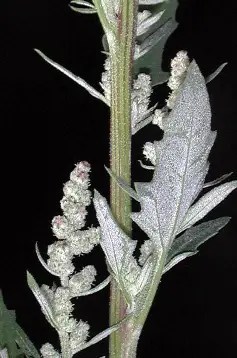
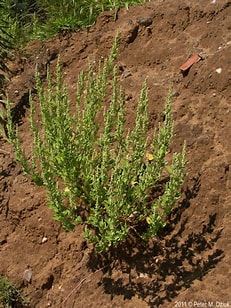

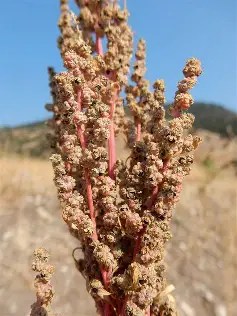
Description: Native, annual herbaceous plant to 1.8 m tall with mostly ovate leaves 1-4 m long. Flowers clustered in spikes or panicles. Seeds 1-1.3 mm wide. Tepals strong keeled. Alternate, 13–152 mm (½–6 in) long, 8–89 mm (3½–3½ in) wide. Leaves alternate and one leaf per node. Lower leaves are largest, irregularly toothed, often with 2 shallow lobes near the base; upper leaves are smaller, narrower, and toothless. Surfaces are green, hairless, and often white-mealy, especially when young. Flowers are very small, 5-parted, in tight clusters (glomerules) in spike-like arrangements at stem tips and leaf axils.
Field Identification: Ill-scented annual to 1.8 m high. Inflorescence farinose (covered with mealy powdery stuff). erect to ascending, with unbranched or much-branched stems. Erect to ascending, with unbranched or much-branched stems. Stems sparsely to densely white-mealy, green to purple striped to red.
Plant Trivia: Known as huauzontle in Nahuatl, reflecting its importance in pre-Columbian diets. Named for French-Swiss physician Jean Louis Berlandier (1805-1851) who colledted plants in Texas and northern Mexico.
Occurrence: Common on various soils in prairies, openings, waste places, and cultivated fields. Native to North America, ranging from Alaska and Canada south to Michoacán, Mexico, and present in every U.S. state except Hawaii. Common in the eastern and central U.S., including Texas.
Bloom Period: Mar-Dec
Plant Use: Cultivated in Mexico as a pseudocereal, leaf vegetable, and for its broccoli-like flowering shoot.
Dichotomous Key to the Genus Chenopodium may be found in Plants of the Texas Coastal Bend by Roy L. Lehman, Ruth O’Brien & Tammy White.
 stxflora