Chenopodium album
Family: Chenopodiaceae
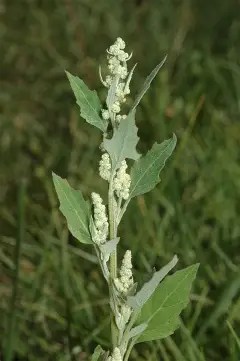
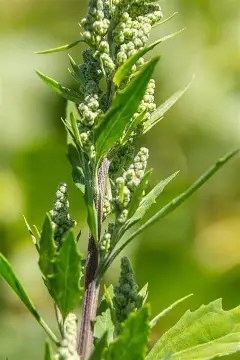


Description: Annual to 1 m or higher with red-striped stems. Leaves broadly rhombic, alternate, varied in appearance, 6-10 cm long, violet or reddish when young. Flowers in spicate panicles. The small flowers are radially symmetrical and grow in small cymes on a dense branched inflorescence 10–40 cm long. The flowers are bisexual. The female, with five tepals which are mealy on outer surface, and shortly united at the base. There are five stamens.
Field Identification: first leaves, near the base of the plant, are toothed and roughly diamond-shaped, 3–7 cm long and 3–6 cm broad. The leaves on the upper part of the flowering stems are entire and lanceolate-rhomboid, 1–5 cm long and 0.4–2 cm broad; they are waxy-coated, repel water and mealy in appearance, with a whitish coat on the underside.
Plant Trivia: Carl Lineaus described the species in 1753. have found seeds in Iron and Viking Age and In Roman sites
Occurrence: Occasional in waste place. Native of Europe. Found around Taft and Corpus Christi Texas.
Bloom Period: Sum-Fall
Plant Use: Young plants are edible raw or cooked like spinach. The leaves and seeds are used a chicken feed and for od for other poultry.
Dichotomous Key: Key to the Genus Chenopodium in our area may be found in Plants of the Texas Coastal Bend by Roy L. Lehman, Ruth O’Brien and Tammy White