Lepidium lasiocarpum wrightii
Family: Brassicaceae

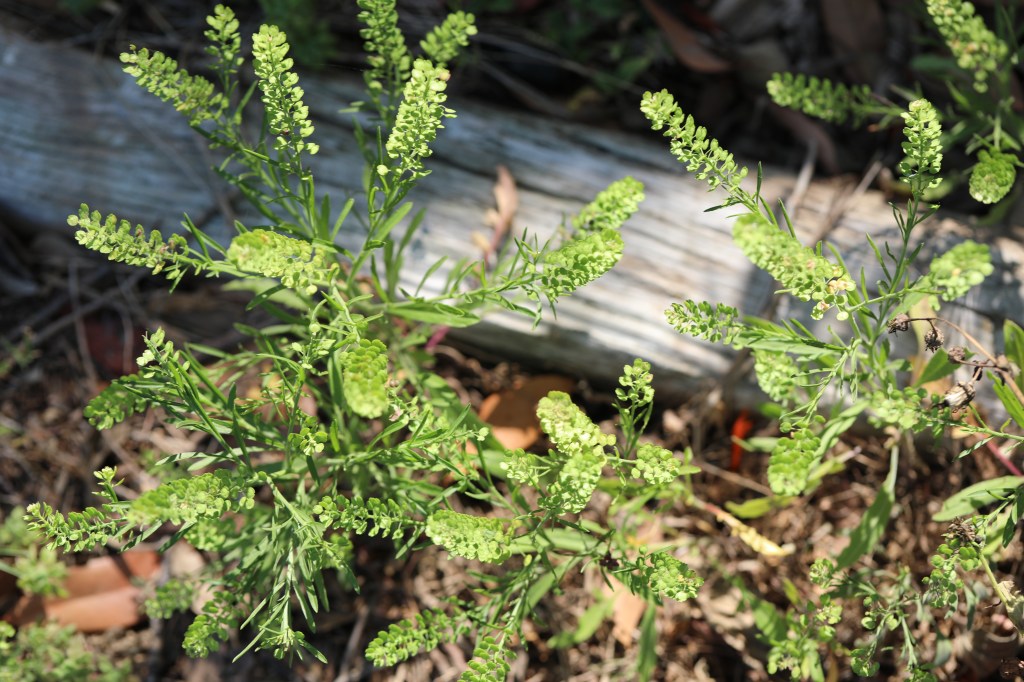
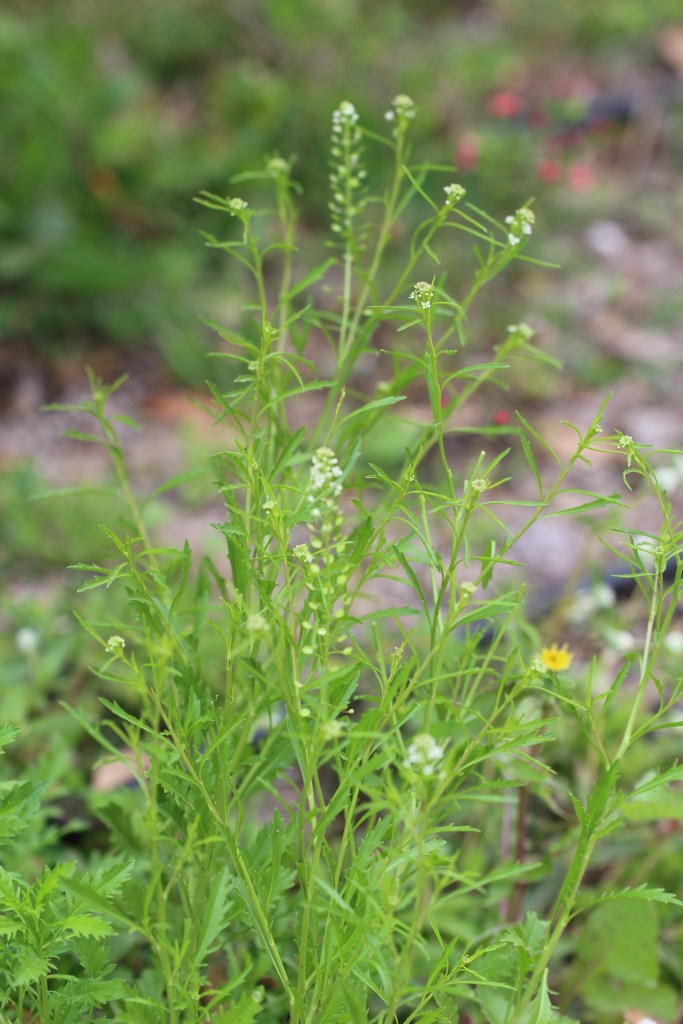
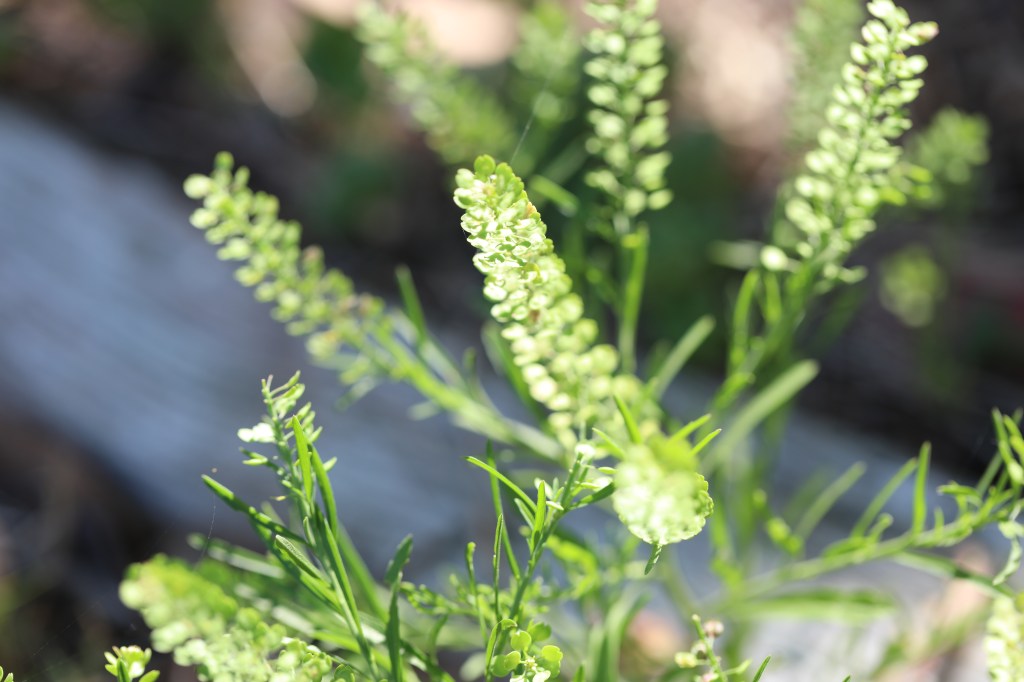
Plant Description: Annual to 30 cm or higher with toothed or entire stem leaves 1-6 cm long. Flowers in terminal racemes. Petals white, scarcely more than 1 mm long, sometimes lacking. The primary characteristic that distinguishes L. lasiocarpum from other similar species is its flattened, hairy fruiting pedicels. It is also distinguished by this combination of traits: plants are tap rooted annuals; stems and leaves are hirsute (pubescent with stiff straight hairs) to hispid (rough with straight hairs) but not covered with scurfy scales; upper stem leaves are sessile to short-petiolate but not clasping the stem; racemes are erect and located at branch tips; flowers have only 2 stamens; seed pods are hairy, at least on the margins, and are not wrinkled. There are 2 subspecies: subsp. wrightii has seed pods covered in pustular-based hairs (small blisters at base of hair), and subsp. lasiocarpum has seed pods with non-pustular hairs.
Field Identification: This is generally a Fall to early summer plant up to about 12-16 cm tall bearing flattened disk like seed pods. Leaves are highly linear and opposite, rough, shiny green. Leaves may be toothed or entire.
Plant Trivia: Dried seeds can be used as a pepper substitute. This subspecies is part of the Lepidium lasiocarpum complex, which includes several varieties and subspecies adapted to different arid and semi-arid environments. It is a small, low-growing forb/herb, typical of dry, open habitats in the Southwestern U.S. and northern Mexico.
Occurrence: Widely scattered on deep sands along the coast or inland. Arizona, New Mexico, Texas; also reported from Mexico (Coahuila, Tamaulipas). This native plant has made itself at home across four southwestern states: Arizona, Louisiana, New Mexico, and Texas.
Bloom Period: February-May
Propagation: Direct seed in fall or early spring for best results. Scatter seeds in areas where you want naturalized growth. Don’t worry about perfect spacing—this plant thrives in informal clusters. Allow some plants to go to seed to ensure future generations. Avoid over-watering, especially once plants are established.
Plant Use: Xeriscape gardens. Great pollinator source.
Key to the species of Lepidium:
- Pedicels flattened; 2-3 times wider than thick…………….L. lasoiocarpum
Pedicels round or slightly flattened………………………………………………………….2
2. Stems conspicuously hairy……………………………………………………..L. austrinum
Stems inconspicuously hairy or glabrous………………………………………………..3
3. Petals equaling or surpassing the sepals…………………………….L. virginicum
Petals shorter than sepals or lacking…………………………………………………………4
4. Basal leaves usually pinnatifid; petals lacking…………………………L. ruderale
Basal leaves pinnatifid or serrate…………………………………………L. densiflorum
 stxflora