Carya illinoinensis
Family: Juglandaceae

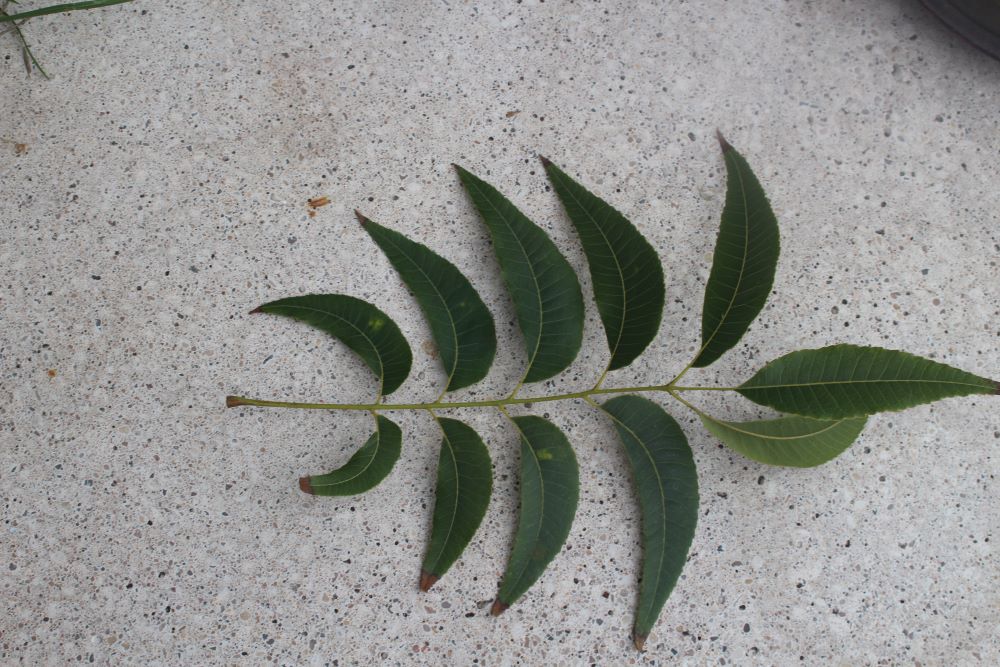
Description: Large tree with a rounded crown, attaining a height of 50 m. The trunk is often very large and may reach a diameter of 2 m. Leaves alternate, deciduous, odd-pinnately compound wit 9-017 leaflets. Leaflets oblong-lanceolate to lanceolate, with toothed margins. Flowers yellowish, male and female flowers separate on the same plant. Fruit in clusters of 3 – 2, nuts, the cusk thin-skinned, 4-winged from top to bottom and enclosing the reddish brown, thin shelled nut, which is f1.4 to 2.5 inches long; seed deeply 2 grooved, and sweet to taste fruit a nut. Bark is grayish brown or light brown, divided by irregular, flattened, interlacing ridges broken into small scaly surfaces. Twigs stoutish, reddish brown with conspicuous orange-brown lenticles.
Plant Trivia: Cultivated for the commercially important pecans. Pecan is the state tree of Texas. Discovered by Hernando DeSoto in 1541 in his wanderings throughout the southeastern United States. As his gold-seeking men emerges from the swamps of Eastern Arkansas they emerged upon high, dry ground where the fields abounded with what Desoto’s chronicler called Walnut trees. However, the description was that of the pecan tree.
by 1762 French Creoles of Louisiana and made pecan into a confection known as the New Orleans praline. Before Americans began crossing the Alleghenies to invade the Mississippi Valley, traders brought these “Mississippi nuts” or “Illinois nuts” across the mountains along with beaver furs and ultimately introduced them to eastern US. The great tree fplanter, Thomas Jefferson set out Pecan trees at Monoticello. . Hes spread the platn to George washington’s Mount Vernon Estate. The pecans planted by both Jefferson and Washington are today the oldest trees visitors will find at these two sites. In the earliy days of pecan exploitation harvesting pecans was by cutting down the trees and having boys or slaves climb through the fall tree to gather the nuts. This is the testimony to early Americans who believed that our resources were endless. The wild pecan became rqre. By 1846 horticulturists were graphing stems onto wild stock (as is done today). The first grafting was done by Antoine, the black slave gardener of Governor Telephore J. Roman in St. James Parish, Louisiana-the Centennial” was produced. Today over 100 cultural varieties of Pecan are known, and every form of grafting native nut tree has been extensively grown in orchards. Georgia is the leading pecan producing state.
Field Identification:
Occurrence: Found on rich river bottomland soils in eastern half of Texas.
Bloom Period: Spring
Plant Use: Important food item to many kinds of wildlife.
 stxflora