Celtis laevigata reticulata subspecies with sugar hackberry (Celtis laevigata laevigata)
Family: Cannabaceae (Ulmaceae)
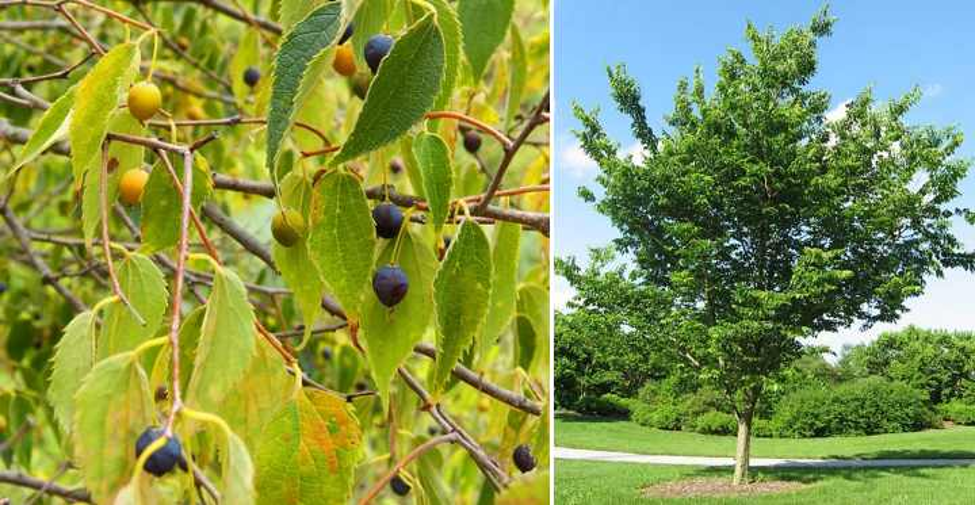
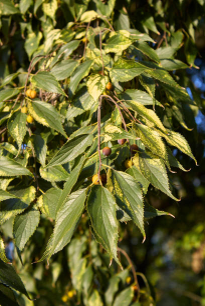
Description: Deciduous, monecious tree to 10 meters tall with ovate leaves 3-8 cm long. Flowers and fruit like sugar hackberry (See Sugar Hackberry). Inflorescence in axillary cymes; pistillate flowers often single, staminate flowers 2–3 per cluster. Ovate, dark green leaves are arranged alternately along stems on petioles up to 9 mm. Leaves alternate, simple petiolate have 3 palmate, distinct veins and have a noticeably rough texture when rubbed between fingers. Leaves with short-villous with scattered; lower surface denser along veins. Whitish to pale grey bark, thickening and becoming bumpy with age (characteristic of both subspecies) ridged on the trunk, smooth on the twigs. Stems ridged, zigzag usually with mucilaginous sap. Leaves up to 3 inches long, smaller than those of Sugar Hackberry, with smooth margins, sometimes with teeth in the apical half, a pointed tip, and a slightly asymmetric base, the upper surface somewhat rough to the touch and darker green than the lower surface, midrib and veins light yellow on the lower. Flowers inconspicuous. Fruit spherical, 0.75 cm diameter, reddish.
Field Identification: Roundish tree with round crown. Flowers in spring. Flowers are small, greenish, monoecious, polygamous fruit one-seeded, reddish or reddish black drupe. Tree often appears “beat up”.
Plant Trivia: If a larger size is desired, extra water throughout the plant’s life will likely be necessary. Indigenous peoples have eaten the fruit both fresh and dried. Some people would roast the berries over a fire, while others would make them into jellies and dried cakes. Parts of the tree have been used by native peoples as a source of medicine, fiber, and dye. The Tohono O’odham utilized the bark to craft sandals. The branches often have deformed bushy growths called witches’-brooms, produced by mites and fungi. The leaves bear rounded, swollen galls caused by tiny, jumping plant lice. This hackberry is mostly confined to areas with a constant water supply. This is the native hackberry of the western United States, mainly in the Southwest, but extending eastward into the prairie states. The sweetish fruit is eaten by wildlife and was a food source for Native Americans. The branches often have deformed bushy growths called witches’-brooms, produced by mites and fungi. The leaves bear rounded, swollen galls caused by tiny, jumping plant lice. This hackberry is mostly confined to areas with a constant water supply.
Occurrence: Native to Western US and Northern Mexico. Frequent on loamy soils in pasture and woods near or along streams and ravines (generally a riparian plant).
Bloom Period: March
Plant Use: Flowers are used by pollinators, and fruit is eaten by birds (mockingbird, cardinal and pyrrhuloxia), small mammals including raccoons and likely other wildlife. Often used in landscaping for its attractive appearance and low maintenance requirements. Fruit eaten fresh, roasted or dried by indigenous people. Hackberry and Anaqua trees ae among the most valuable trees for wildlife.
Propagation: Can be grown from seed or transplanted suckers. This plant needs supplemental water when first planted but is drought tolerance once established.
Dichotomous Key to the Genis Celtis:
- Branches not spiny……………………………………………………….. C. laevigata*
Branches spiny…………………………………………………………..…….C. pallida
*Celtis l. laevigata: Deciduous tree to 16 m with lanceolate to ovate leaves 4-8 cm long. Will intergrade with Celtis l reticulata.
 stxflora