Ipomea amnicola
Family: Convolvulaceae
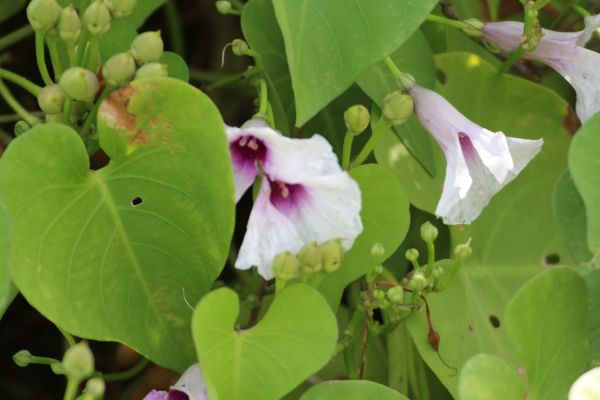
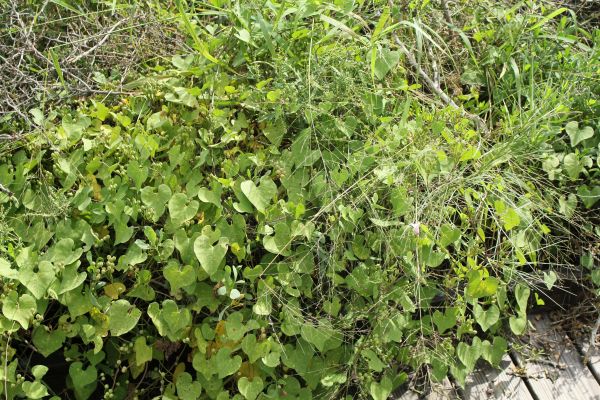


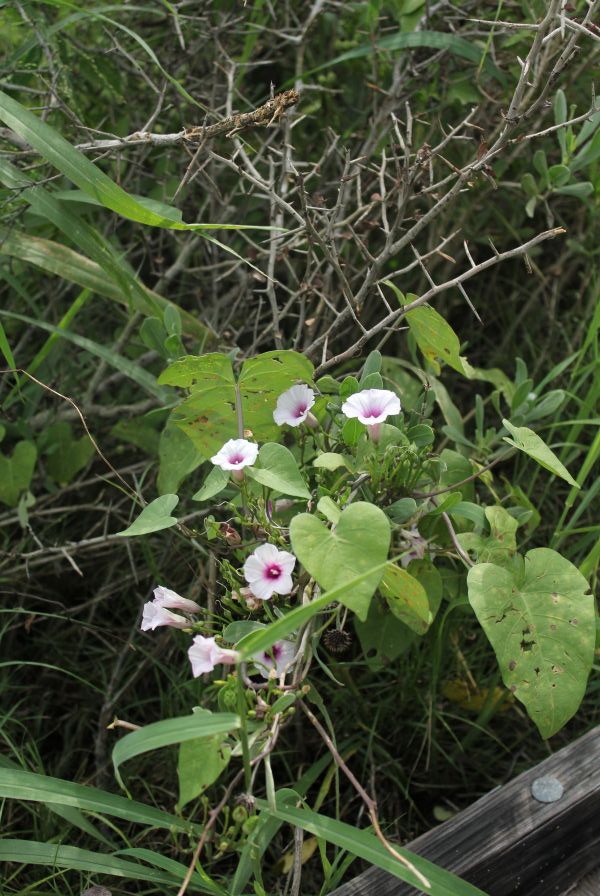
Description: Twining or trailing perennial vine to 5 m long. Leaves alternate, heart-shaped, sometimes 3-lobed, up to 9 cm long. Leaves are petiolate, ovate to broadly ovate, 2–8 cm long, with cordate bases and rounded auricles; abaxially slightly glaucous; petioles 1–10 cm. Flowers radial, funnel shaped, white to purplish with a purple center up to 3 cm long. Petals are grown together. Fruit is a brown, globose capsule subtended by the dried sepals.
Field Identification: This species has calyx lobes that are blunt or rounded, not tapering to a point. Conspicuous flower white to whitish with reddish center. Twining perennial, somewhat succulent, completely glabrous (hairless). Small, pale lilac to pink with a dark center; funnel-shaped corolla 2–3 cm wide, unlobed; sepals slightly unequal; inflorescences as dense cymes.
Plant Trivia: Native of Paraguay.
Occurrence: Introduced species. Frequent in fields, wase places swales, ditches, and ravines, often forming a canopy over bushes and small trees.
Bloom Period: Year round
Plant Use:
Dichotomous Key to the Genus Ipomoea May Be Found: Plants of the Texas Coastal Bend by Roy L. Lehman, Ruth O’Brien & Tammy White.
 stxflora