Caesalpinia mexicana
Family: Fabaceae
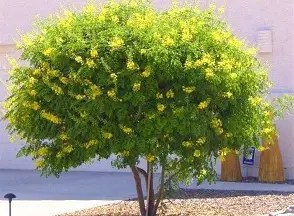
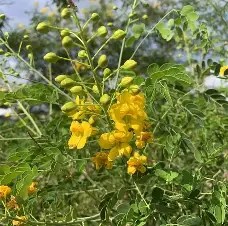
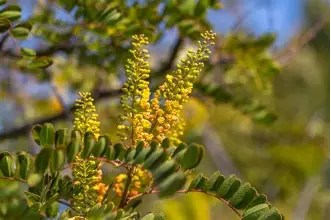
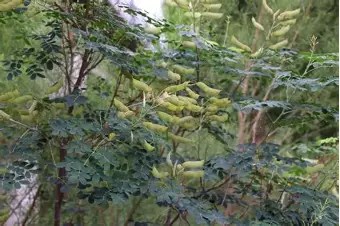
Description: Shrub to tree with green leaflets contrasting with bright-yellow flowers and tan pods. Height to 30 ft, usually half that. Flowers many, small, bright-yellow flowers in clusters (racemes); much of year. Fruit tan, inflated, oblong pods with light-brown seeds. Leaves alternate, twice compound. leaflets dull-green above and paler beneath. Spineless. Bark is smooth, mottled, light or dark-gray, older trunks are fissured.
Field Identification: This plant produces showy clusters of bright yellow flowers in racemes 7–15 cm (3–6 inches) long, blooming from summer into fall in warm climates. The flowers are often fragrant. Foliage is evergreen, dark green, and finely textured, with bipinnate leaflets. After flowering, it forms slightly curled seedpods about 5-8 cm (2–3 inches) long.
Plant Trivia: When the seed pod ripens, in the heat of the day they suddenly pop open, throwing the seeds some distance. The seeds are thrown with such force that when they hit a building, it sounds as if someone were throwing gravel.
Occurrence: Thisis a thornless shrub or small tree native to parts of Mexico and the extreme lower Rio Grande Valley of Texas, also found along the Gulf coast.
Bloom Period: Spr-Sum but may bloom year-round.
Plant Use: Attracts hummingbirds and butterflies. Valued as an ornamental accent shrub or small tree for Mediterranean, tropical, and desert gardens. Suitable for beds, borders, patios, parks, and xeriscaping. Its flowers and foliage add seasonal interest and wildlife value. Acts as a host plant for the caterpillars of the curve-winged metalmark butterfly (Emesis emesia).
Dichotomous Key to the Genus Caesalpinia:
- Plant is a tree…………………………………………………….…..C. mexicania
Plant a shrub…………………………………..……………………..………………….2
2. Leaflets oblong to obovate, 4-5 pairs/pinna……C. drummondii
Leaflets ovate to circular, 2-3 pairs/ pinna….C. phyllanthoides

