Phyllanthus polygonoides
Family: Euphorbiaceae
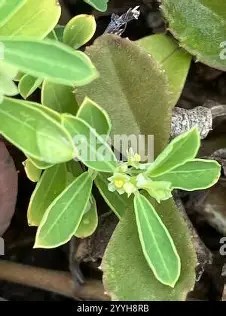
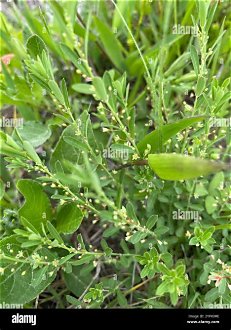
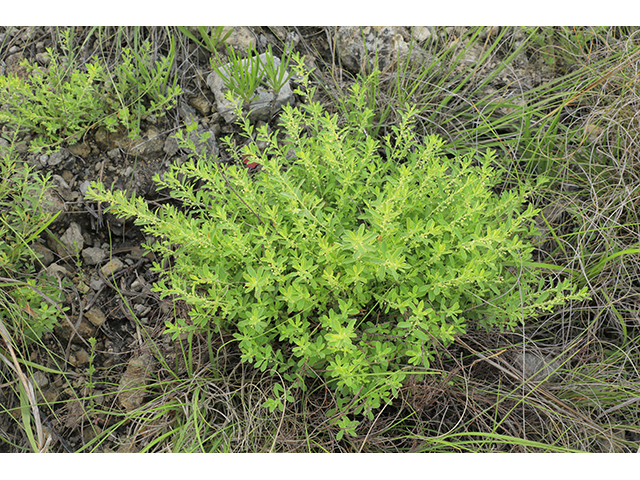
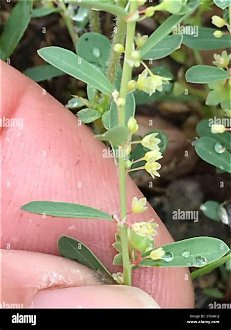
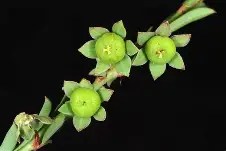
Description: Perennial to 40 cm high with oblong to obovate leaves 5-15 mm long. Flowers much as in P. abnormis. Monoecious (male and female flowers on the same plant); small, inconspicuous axillary cymes with greenish-yellow perianth lobes and white margins. Forms clumps from a tap rooted base; not rosetted. Staminate (male) flowers are greenish yellow with white margins, sometimes suffused with red. They typically have 3 stamens. Pistillate (female) flowers have only pistils, and are green with white margins. Staminate and pistillate flowers may occur on the same plant.
Field Identification: Herbaceous perennial, often clump-forming from a woody base; stems ascending, slender, with overlapping leaves glaucous, with clasping stipules.
Plant Trivia: Phyllanthus from Greek phyllon (leaf) and anthos (flower), referring to leaf-like floral parts; polygonoides means “resembling Polygonum” due to leaf and stem similarities to smartweeds/knotweeds.
Occurrence: Frequent on damp soils in streams bottoms, ditches, swales, and other low places. Native to the central and southwestern U.S. (Arizona, Arkansas, Louisiana, Missouri, New Mexico, Oklahoma, Texas) and northern/central Mexico.
Bloom Period: April- Nov
Plant Use: Supports biodiversity in native plant communities and restorations. Ornamental.
Dichotomous Key to the Genus Phyllanthus:
- Fruiting calyx, lobes 1.5-2.5 mm long…………….……P. polgonoides
Fruiting calyx, lobes 0.7-1.2 mm long…………………………………..……2
2. Leaves 1-4 mm wide………………………………………….……P. abnormis
Leaves 4-10 mm wide…………………….…………….…………….P. pudens
 stxflora