Heliotropium indicum
Family: Boraginaceae
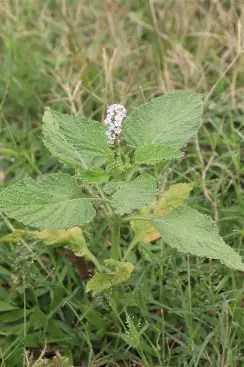
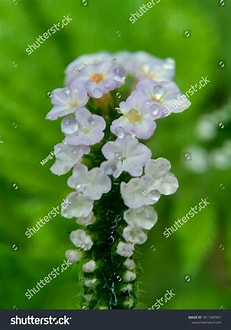
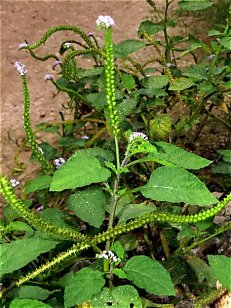
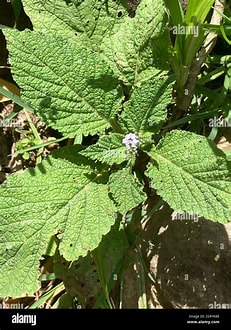
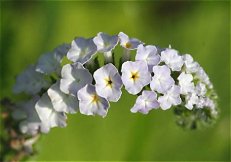
Description: This plant is an annual herbaceous plant 20–60 cm tall. Leaves are alternate to subopposite, pubescent with wavy margins, ovate to elliptic 3-11 cm long. Flowers in unrolling spikes, the corolla 3-3.5 mm wide, blue-violet. This is one of the largest heliotropes in Texas
Field Identification: All Heliotropum species inflorescence appears as curled caterpillars. This is an annual, erect, branched plant that can grow to a height of about 15–50 cm (5.9–19.7 in). It has a hairy stem, bearing alternating ovate to oblong-ovate leaves. It has small white or purple flowers with a green calyx; five stamens attached to ne on a corolla tube; a terminal style and a four-lobed ovary. Unlike Seaside Heliotrope which often grows in large patches, this species tends to grow in isolation.
Plant Trivia: The plant contains hepatotoxic pyrrolizidine alkaloids (e.g., indicine, heliotrine) that can cause liver damage, veno-occlusive disease, and carcinogenic effects. The whole plant is buried and, after the fleshy tissue has rotted away, the remaining fiber is used to make false hair for women.
Occurrence: It is widely distributed across tropical regions. Locally found in the Tivoli, Texas, Aransas National Wildlife Refuge Alice, Texas and along the San Antonio SE of Goliad. Occurs in damp soil, mostly in stream bottoms. Native to seasonally dry tropical regions of South America (Peru, Brazil, N. Argentina). Naturalized in many countries with similar climate. Common in waste places, roadsides, riverbanks, agricultural fields, and moist sunny areas.
Bloom Period: July-Nov
- Plant Use: Despite its toxicity it has ben used medicinally to treat wounds, skin ulcers, infections, fevers and inflammations and poultices and decoctions.
Dichotomous Key to the Genus Heliotropium is found in Plants of the Texas Coastal Bend by Roy L. Lehman, Ruth O’Brien & Tammy White.

