Baccharis halimifolia
Family: Asteraceae
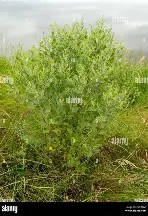
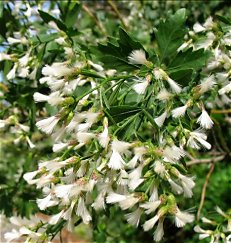
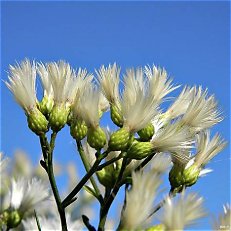
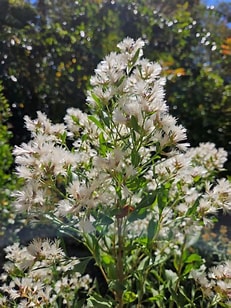
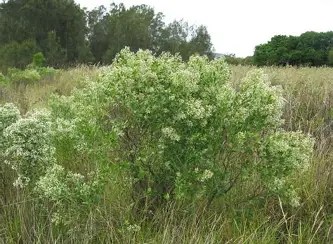
Description: Deciduous shrub to 2.3 m or higher with leaves 3-5 cm long. Leaves are simple, alternate, thick, egg-shaped to rhombic leaves mostly have coarse teeth, with the uppermost leaves entire. Leaves in large panicles, 5-15 mm high, discoid. Corolla white.
Field Identification: May be tall as small tree. with male and female flowers on separate individuals. Their flowers are borne in numerous small, compact heads in large leafy terminal inflorescences, with the snowy-white, cotton-like female flower-heads showy and conspicuous at a distance. The species is sometimes confused with the Marsh Eider, Iva frutescens, with which it often co-occurs, but the Baccharis has its leaves alternate, while those of the Iva are opposite.
Plant Trivia: Was first described and named by Carl Linneaus in his Species Plantarum, published in 1753. The seeds of Baccharis halimifolia are toxic to humans.
Occurrence: Frequent in low or damp places along the coast from Aransas Refuge to Aransas Pass and occasional along streams. Widespread from Nova Scotia to Texas and most of the southeast United States. It is a N. American native.
Bloom Period: Sept-Nov
Plant Use: Abundant nectar attracts butterflies; dense shrubs also provide wildlife food and cover. It is occasionally cultivated and is considered useful as a hedge or border as well as a specimen plant. In southern Louisiana, it has been traditionally used as a medicine to treat inflamed kidneys and fever
Dichotomous Key to the Genus Baccharis:
- Leaves elliptic or rhomboid……B. halimifolia
Leaves narrowly lanceolate or linear…………2
2. Leaves less than 5 mm wide…………………..….3
Leaves less than 5 mm wide…..B. salicifolia
3. Involucre 4-5 mm high……………..B. neglecta
Involucre 6-9 mm high………………..B. texana

