Nama jamaicense
Family: Hydrophyllaceae
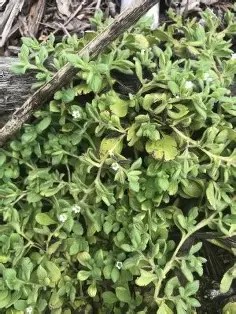


Plant Description: Annual, herbaceous plant with usually prostrate stems 10-50 cm long. Typically forms dense mats along the ground, making it an effective pioneer species in disturbed areas Leaves alternate, slightly hairy obovate-spatulate, 1-7 cm long. Alternate leaves.Flowers mostly solitary, radial, tubelike, the corolla 6-7 mm long, white, petals united basally. Flowers are usually white or pale blue, sometimes tinged with lavender-pink, and bloom in clusters
Plant Trivia: The plant’s succulent stems allow it to store water, enhancing its resilience in dry conditions.
Field Identification: Shoots with basal leaves and cauline leaves, cauline leaves appearing subopposite and with winged stems from decumbent bases forming 2 green wings per leaf, stiff short–hairy and with inconspicuous, colorless, subsessile to short–stalked glandular hairs, scattered nonglandular hairs sometimes > 0.5 mm long.
Occurrence: Common on various soils in prairies, openings, fields and wase places. It is native to the West Indies, southern United States (including Texas and peninsular Florida), Mexico, Central America, and parts of South America.
Bloom Period: Spring-Summer
Plant Use: Contributes to soil stabilization and ecosystem biodiversity. Its flowers provide nectar and pollen for pollinators, while its foliage offers habitat and shelter for insects and small wildlife.
Propagation: propagated from seeds or stem cuttings, with seeds benefiting from overnight soaking to improve germination.
Key to the species of Nama:
- Calyx tube 2-4 mm long………………………………………………N. stenocarpum
Calyx not tubular……………………………………………………………………………………..2
2. Corolla white…………………………………………………………………….N. jamaicense
Corolla purple…………………………………………………………………………………………3
3. Leaves roughish………………………………………………………………….N. hispidum
Leaves smooth……………………………………………………………….N. parvifolium
 stxflora