Drosera brevifolia
Family: Pontederiaceae (Droseraceae)

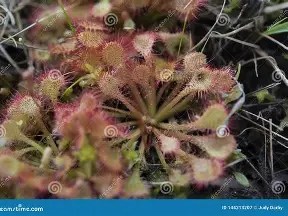

Description: Annual or perennial plant but it tends to be a biennial bloomer to 12 cm high with narrowly triangular leaves to 1.5 cm long, forming a rosette. Its basal leaves are obovate to spatulate in shape. Flowers in racemes (spikes), the petals 4-7 mm long, light violet to rose lavender. Insectivorous.
Field Identification: Insectivorous herbs growing in damp soils. Leaves red or green, with gland-tipped hair. This plant is easily missed. It often grows in vegetated soils that are saturated in water and among taller vegetation.
Plant Trivia: Sundew is an insectivorous plant with a unique way of catching its prey. The paddle-shaped leaves of the sundew form a rosette at the base, greenish to reddish and densely covered on the upper surface with hairs exuding a clear, sticky liquid which attracts and traps various kinds of insects.
Occurrence: Occasional in moist sand. Known from Padre Island, Ingleside, Flour Bluff and Welder Refuge and along Sarco Creek south of Goliad. It is found in environments with wet, peaty, or sandy soil. It has been found in habitats such as along the edges of marshes, ponds, and swamps. The distribution of this plant in North America is the southeastern United States including Texas. It’s also found in South America on the south coast of Brazil.
Bloom Period: Feb-Apr
Plant Use: The benefits of this species is they act as natural pest controls. They act as a living trap for household pests, reducing the need for chemical insecticides. They also have medicinal uses, historically used to treat bronchitis, asthma, and hoping cough because of compounds that act as antitussives and anti-inflammatories.
They also have educational and scientific value because they demonstrate plant adaption to poor soil conditions by acquiring nutrients through carnivory rather than roots.
They also have aesthetic appeal, with these glistening nectar-like droplets and vibrant colors. They make attractive exotic house plants.
Dichotomous Key for the Genus Drosera: There is only one species of this genus in our area.

