Evolvulus alsinoides angustifolius
Family: Convolvulaceae
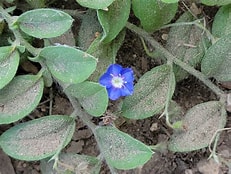
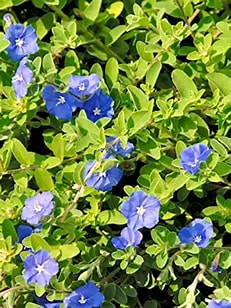
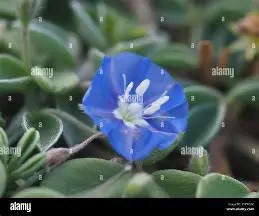

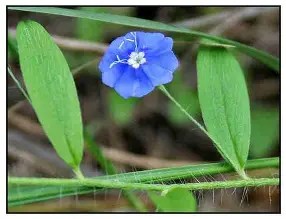
Description: Perennial with spreading or ascending stems to 50 cm or longer. Small, hairy perennial. Leaves 1-2 m long, ovate, oval or narrower. Flowers are funnel shaped, blue, sometimes white or whitish up to 5 mm wide. Corolla 6-9 mm wide, light blue. The ovary is glabrous and is surmounted by two free styles.
Field Identification: Atypical appearance for a morning glory in that it is a small plant that could easily be in a hanging basket. Flowers are petiolate or subsessile, elliptic to narrowly elliptic, 0.7–2.5 cm long and 5–10 mm wide, with silky pubescence. Stems are ascending, slender, with appressed and spreading hairs.
Plant Trivia: The genus name comes from a Latin word meaning “untwist,” referring to the nontwining habit of this plant (compared to many members of this family. The Spanish common name translates as “adder’s eye.” Linnaeus, first described in 1753. This variety is recognized in some regional floras, particularly in Texas, as a morphologically distinct form with narrower leaves.
Occurrence: Frequent on dry sand and caliche in openings or around brush in western half of the Texas Coastal Bend. Coastal hammocks, coastal rock barrens, disturbed areas, and shelly coastal soils. Also occurs in grasslands, woodlands, foreshores, roadsides, and as a weed in cultivated areas.
Bloom Period: Year round
Plant Use: Used as animal food and in traditional medicine in some regions.
Dichotomous Key to the Genus Evolvulus:
- Leaves hairy on both surfaces…………..E. alisinoides
Leaves glabrous above………………………..E. sericeus
 stxflora