Paspalum dilatatum
Family: Poaceae
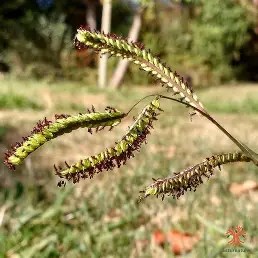
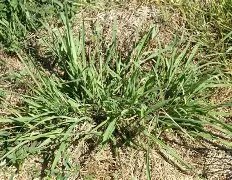

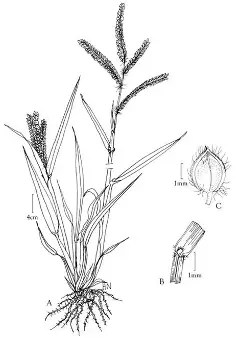

Description: Perennial with short rhizomes forming a knotty base. Culms to 1.75 m long, erect. Ligules 1.5-4 mm long, membranous. Panicles terminal with 2-7 racemosely arranged branches. Pubescence along the margins of the lower lemmas and upper glumes is distinctive. It is a bunch grass forming dense, stiff clumps in the soil and spreading outward. It is easily identified by its blade-shaped gray-green leaves and distinctive seedhead with 2-10 drooping finger-like racemes lined with egg-shaped seeds.
Location: Native of Brazil and Argentina. It is present in the southern half of N. America, southern Europe, much of Africa, Australia, and New Zealand, and many tropical and subtropical areas.
Soil Type: Most soils.
Trivia: This is a non-native grass introduced from S. America. While considered a noxious weed in some parts of Texas, it is a good riparian plant. Ergot alkaloids are occasionally present, causing “paspalum staggers” in livestock. The common name dallisgrass was derived from A. T. Dallis, a 19th-century farmer who grew the species extensively near La Grange, Georgia. highly adapted grass, it is exceptionally tolerant of drought due to its thick rhizomes, low rainfall, and mild frost.
Bloom: May-Oct
Importance: Originally seeded as a forage species, now a weed of disturbed areas, roadsides, lawns, and waste places. It is valuable forage for cattle, goats, sheep, and horses as it withstands heavy grazing; produces high-quality silage, making it an important livestock food source in dry seasons; deep root system and vigorous growth make it a valuable plant for soil stabilization and erosion control; ground cover in disturbed sites; and habitat and food source for some wildlife and birds.

