Oenothera laciniata
Family: Onagraceae
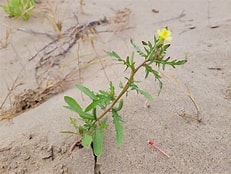
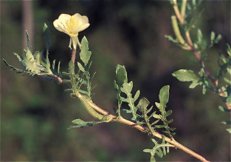


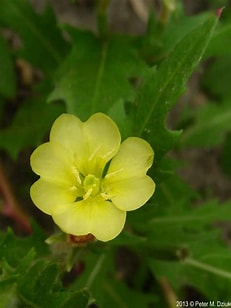
Description: Is an annual or short-lived perennial herb that produces spreading stems from a hairy rosette of deeply cut or lobed leaves. The leaves alternate and vary from oblanceolate to elliptic and may be irregularly lobed or pinnatifid. Basal and lower stem leaves can reach up to 15 cm long and 3.5 cm wide, while upper leaves are smaller and often stalkless. The stems are erect to ascending, sometimes sprawling, and can be single or many-branched, with varying hairiness. The flowers are solitary in the axils of upper leaves, with four yellow heart-shaped petals about 2 cm long that fade to orange, pink, or red with age. Each flower has eight yellow stamens surrounding a central style with a cross-shaped stigma. The sepals are yellowish-green, hairy, and bend back as the flower develops. Flowers open in the evening and close during the heat of the day
Field Identification: Resembling O. Grandis but with petals only 5-18 mm long. The cut-leaved evening primrose grows 10 – 60 cm (4-24 inches) high, erect or prostrate. Leaves are alternate, simple, pinnately cleft into rounded lobes, or sometimes merely wavy-edged or toothed. Usually they are about 5 cm (2 inches) long and 1 cm (1/2 inch) wide. The small, pale-yellow flowers are borne singly in the axils, with 4 heart shaped petals 5 mm – 10 mm (1/5-3/5 inch) long that turn downward, 8 stamens, and 1 pistil. They have 4 pinkish sepals, united at the base to form a tube.
Plant Trivia: There are 8 Oenothera species in the Texas Coastal Bend. This species has the smallest yellow flowers of the Oenothera genus. O. laciniata hybridizes with O. grandis.
Occurrence: Native to eastern North America. In its native range, it thrives in pine flatwoods, pine savannas, shrub bogs, meadows, fields, and anthropogenically disturbed areas. It is adaptable to sandy soil and can be found along roadsides and in nursery fields. While it prefers non-wetlands, it occasionally occurs in wetland areas.Frequent on sandy soils throughout the area.
Bloom Period: Feb- June
Plant Use: This plant attracts native bees, butterflies, and moths, making it valuable for pollinator gardens. Birds such as bobwhite quail, mourning doves, and goldfinches feed on its seeds. It can be grown as a groundcover or in multi-species plantings, and it spreads readily by self-seeding.
Propagation: Propagation is possible via seed or root division, and seeds are commercially available.
Dichotomous Key to the Genus Oenothera: Plants of the Texas Coastal Bend by Roy L. Lehman, Ruth O’Brien & Tammy White
 stxflora