Hypochaeris radicta
Family: Asteraceae

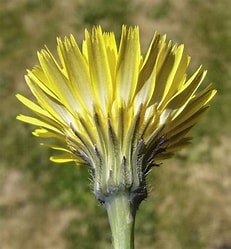
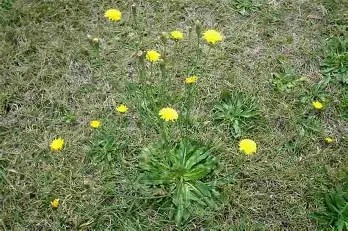
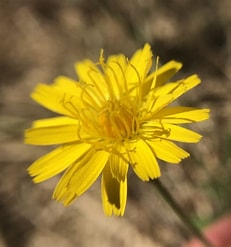
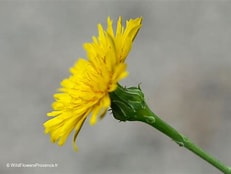
Description: The leaves which may grow up to 20 cm (8 inches) long, are lobed and covered in coarse hair, forming a low-lying rosette around a central taproot. It is a low-lying perennial herb that typically grows between 15 to 80 cm (6-32 inches) in height. It features a rosette of lobed, hairy leaves that can reach up to 20 cm (8 inches) long. The plant produces bright yellow flower heads on forked stems, which resemble those of dandelions but are distinct in structure. Corollas 10-16 mm long, bright yellow, occasionally somewhat grayish- or lavender-tinged on the outer surface. Pappus 10-12 mm long, of numerous bristles, the outer series shorter and finely barbed, the others longer and plumose, straw-colored, persistent at fruiting. Basal and alternate, the stem leaves much-reduced and mostly scalelike. Basal leaves sessile or with a short, winged petiole. Leaf blades 3-35 cm long, narrowly oblong to oblanceolate, ranging from pinnately several-lobed with bluntly triangular to oblong- rounded lobes and rounded sinuses to unlobed but with few to several broad, shallow, spreading teeth, both surfaces moderately to densely pubescent with relatively coarse, white, spreading hairs. Involucre 10-15 mm long at flowering, elongating to 17-25 mm at fruiting, cup-shaped to broadly cylindrical, the bracts mostly 20-28 in 4-6 overlapping series, ovate to narrowly oblong-lanceolate, glabrous or sparsely to moderately hairy along the midnerve, green, the margins often thin and pale, the tip appressed-ascending, often with a minute fringe of hairs, sometimes purplish-tinged. Disk florets absent. Ligulate florets 25-55 in number.
Field Identification: Is commonly mistaken for true dandelions The plants carry similar flowers which form windborne seeds. However, cat’s ear flowering stems are forked and solid, whereas dandelions possess unforked stems that are hollow. Both plants have a rosette of leaves and a central taproot. The leaves of dandelions are jagged in appearance, whereas those of cat’s ear are more lobe-shaped and hairy. All parts of the plant exude a milky sap when cut. The flowers mature into seeds that are dispersed by the wind, resembling parachutes. Receptacle with a chaffy bract wrapped around the base of each floret, these usually extending just past the pappus at flowering and elongating as the fruits mature, very narrowly triangular, white, papery.
Plant Trivia: Introduced to various regions, including North America, Australia, and New Zealand, where it often becomes invasive. Cat’s Ear is derived from the words cat’s ear and refers to the shape and fine hair on the leaves resembling that of the ear of a cat.
Occurrence: This is an introduced relative to the dandelion is very common parts of the U.S., including the Pacific Northwest and New England states.
Bloom Period: May-Aug

