Dolichandra unguis‑cati (Macfadyena unguis-cati)
Family: Bignoniaceae
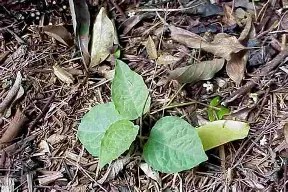
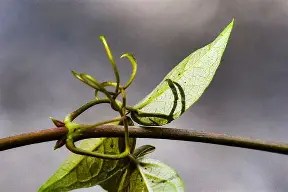
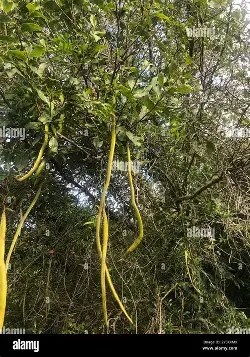
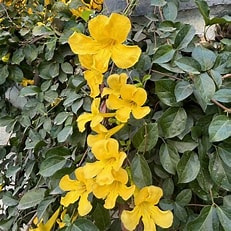
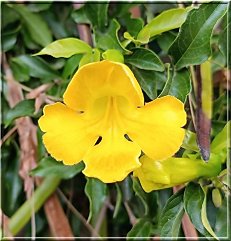
Description: Perennial woody vine. Leaves opposite, paired, usually two leaflets with a claw‑like tendril between them; ovate or lanceolate shaped leaves; entire margins; dark green. Bright yellow trumpet-like flowers are, trumpet‑shaped, typically 3–5 cm long; solitary or in axillary clusters. Produces large underground tubers that store energy and make removal difficult. Seeds are oblong winged seeds that are wind-dispersed.
Field Identification: Vine with Three‑pronged “cat’s claws”.
Plant Trivia: Cat’s claw vine is a long-lived plant that grows relatively slowly. In the seedling stage, cat’s claw directs nutrients to its underground roots and tubers and then rapidly elongates stems. It is adapted to a wide variety of soil types, enabling establishment in all manner of habitats. Areas that are susceptible to invasion to cat’s claw include river or stream banks, near human habitations and undisturbed hammocks.
Occurrence: Native of neotropical regions of Central and South America. This is a highly invasive plant capable of pulling down trees.
Bloom Period: Mar-Aug
Plant Use:
Special Note: The best control is not to acquire it. If you have it, get rid of it by the following. It will require multiple treatments with any of the treatments:
Chemical
- Cut stem: 100% glyphosate product (cut the vines and paint cut ends with glyphosate)
- Foliar: 2–3% glyphosate product, 2% Garlon 3A
- Basal bark: 100% Triclopyr

