Condalia hookeri
Family: Rhamnaceae
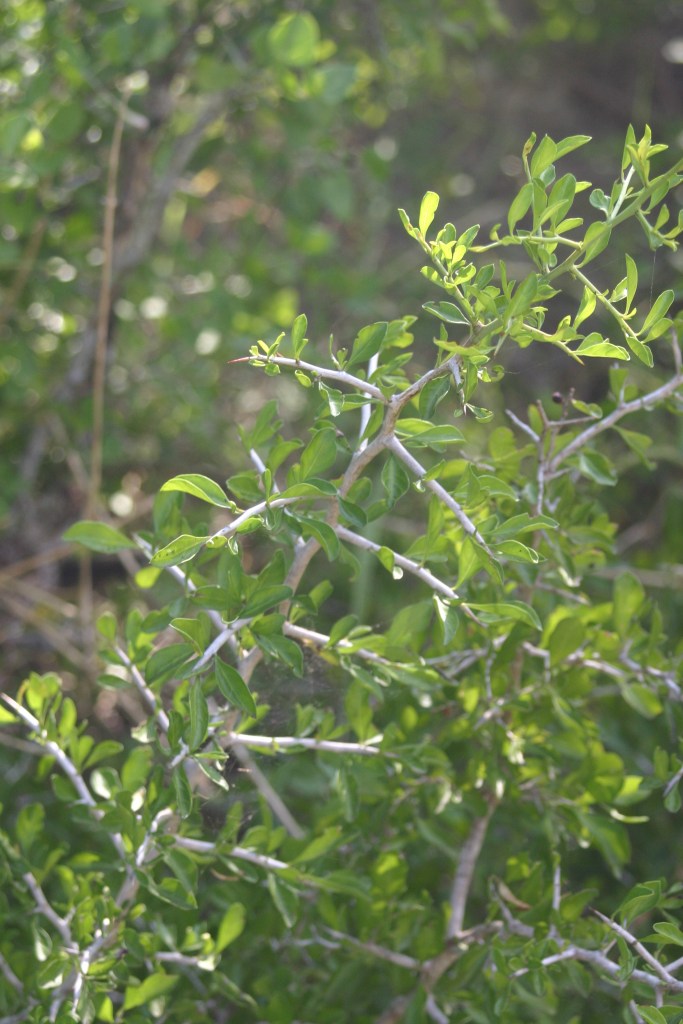
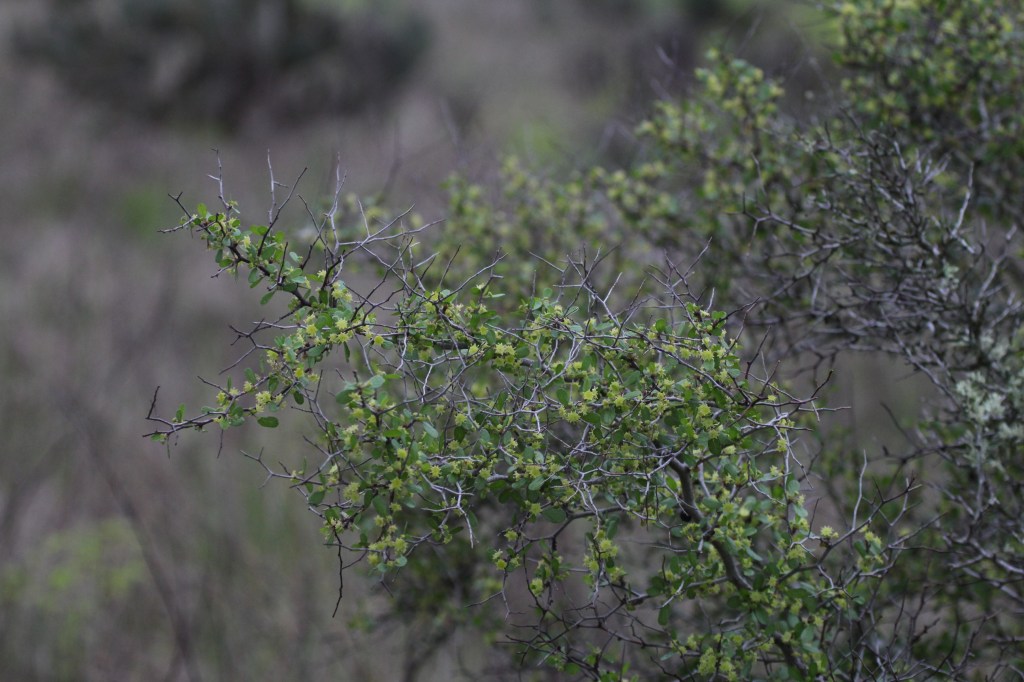
Plant Description: Spine-tipped evergreen shrub or small tree to 4 m or higher. Leaves 1 – 3 cm long, alternate or fascicled with entire margins, spatulate to obovate, yellow-green, in tight groups. Flowers few per leaf axil, the yellow-green sepals about 1 mm long. Petals lacking. Fruits 5 – 8 mm wide, black drupe. Thicket forming.
Plant Trivia:
Field Identification: Condalia is distinguished from other members of the family by its thorns and its leaves, which are broadest above the middle. Leaves of C. hookeri do not have prominent veins; those of C. spathulata have somewhat prominent veins. Small, shiny, light lime-green leaves alternate on grayish branches that end in sharp spines.
Occurrence: Comon on various soils in brushy pastures, occasional in wooded stream beds. Occurs inland mostly. Found in coastal prairies, Rio Grande Plains, Edwards Plateau and Trans-Pecos.
Bloom Period: Spring to Fall
Plant Use: The ripe drupes are an important food source for birds and have been used to produce a purple dye. The heartwood is red, dense, and heavy, sinking in water. Containing about 15% crude protein, they are frequently browsed by white-tailed deer. Fruits are eaten by coyote, raccoon, bobwhite, and scaled quail, and several species of passerine birds. It also provides cover for wildlife. Fruits are edible, sweet, and succulent.
Key to the species of Condalia:
- Leaves 5 – 12 mm wide……………………………………………………………..C. hookeri
Leaves 1 – 2 mm wide ………………………………………………………….C. spathulata
 stxflora