Cynodon dactylon
Family: Poaceae
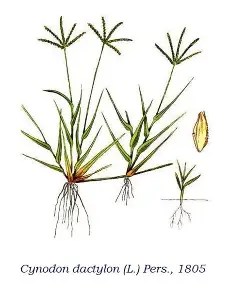
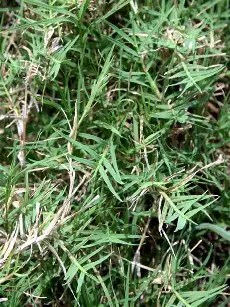
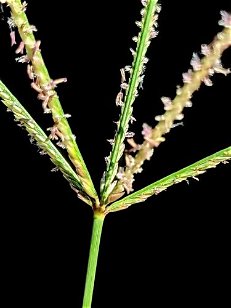
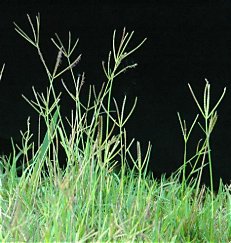
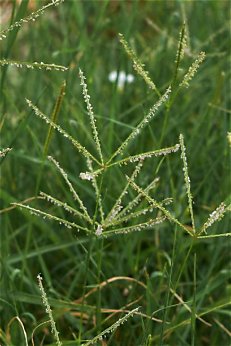
Description: A stoloniferous and usually rhizomatous grass. Panicles with 2-9 branches. Branches in a single whorl, ascending to only slightly divergent. The stems are slightly flattened, often white or green, and occasionally tinged purple in color. The seed heads are produced in a cluster of 2 to 6 spikes together at the top of the stem, each spike 2–5 cm (0.79–1.97 in) long. Has a deep root system. When grown in penetrable soil under drought conditions, its roots can grow to over 2 m (6.6 ft) deep, though most of the root mass is less than 60 cm (24 in) under the surface. The grass creeps along the ground with its stolons and roots wherever a node touches the ground, forming a dense mat. This grass reproduces through seeds, stolons, and rhizomes.
Location: It is native to Europe, Africa, Australia, and much of Asia and has been introduced to the Americas.
Soil Type: Grows in most soils.
Trivia: Source of hay fever I humans and photosensitivity, staggers syndrome, and acute respiratory distress syndrome in livestock. Probably occurs in every Texas county. It is considered an invasive plant. Has been used in cultivated saline soils in California. Eaten by dogs to induce vomiting. Spreads three ways: underground rhizomes, above ground runners and seeds. It is a good riparian colonizer since it spreads rapidly. Due to its origins its invasiveness can be problematic. Once you have it, you have it forever.
Importance: Used for lawns, golf courses ( and other athletic fields), and pastures and as hay. This grass is used medicinally, as diuretic and an astringent and for religious purposes in a variety of cultures and religions.

