Casuarina equisetifolia
Family: Causuarinaceae
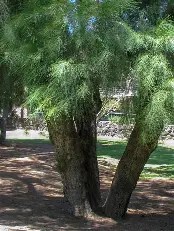


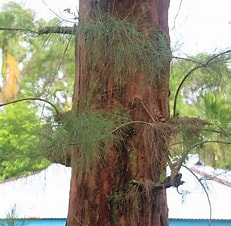
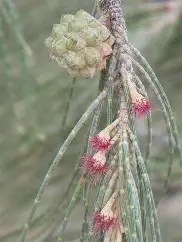
Description: Typically grows to heights of 6–35 meters (20–115 feet), with some specimens reaching up to 40 meters (131 feet). Feathery foliage. The leaves are reduced to tiny scale-like structures arranged in whorls of 6 to 8, giving the tree a pine-like appearance. The branchlets are slender and drooping, measuring up to 30 cm (12 inches) long. The bark is rough, grey-brown, and can be scaly or furrowed in older trees, while younger trees have smooth, greyish bark. This plant is monoecious, meaning it has both male and female flowers on the same tree. Male flowers appear in simple spikes, while female flowers are found on short peduncles.
Field Identification: Tall pine-like tree often with multiple trunks. Rough bark and roots partly above ground level.
Plant Trivia: The specific epithet equisetifolia means ‘horsehair-leaved’. This species is sometimes given the common name “Australian pine” because it has features that seem superficially like those of a pine, but it is not a conifer.
Occurrence: Native to Australia, New Guinea, Southeast Asia, and India, often found in sandy soils along coastlines and estuaries.
Bloom Period: Spring
Plant Use: This plant is a pioneer species that stabilizes sandy soils and is tolerant of salt spray, making it ideal for coastal and dune ecosystems. The tree also forms nitrogen-fixing associations with soil microbes, enhancing soil fertility. Wood is dense and durable, making it suitable for construction, fuel, and as a windbreak. Traditionally, the bark has been used to treat dysentery and diarrhea, while the twigs are used for various ailments. Planted as an ornamental. It is often planted in parks and gardens, particularly in poor, infertile soils or along seashores. The heartwood is pale red, pale brown to dark red-brown, moderately to sharply differentiated from the sapwood, which is yellowish or pale yellow-brown with a pink tinge. The grain is coarse, straight, slightly interlocked or wavy; texture fine to moderately fine and even. Shrinkage is moderate to very high, and in the latter case the wood is difficult to season due to severe warping and checking. Wood is hard to very hard and strong. The heartwood is highly resistant to pressure treatment, but sapwood is amenable to such treatment. Heartwood is also resistant to dry-wood termites. The wood is used for house posts, rafters, shingles, electric poles, tool handles, oars, wagon wheels and mine props.
 stxflora