Justica americana
Family: Acanthaceae
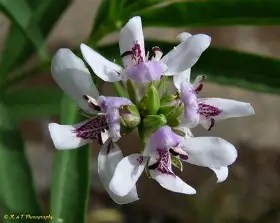
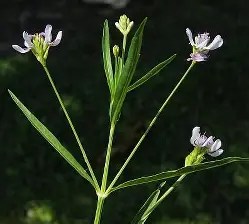
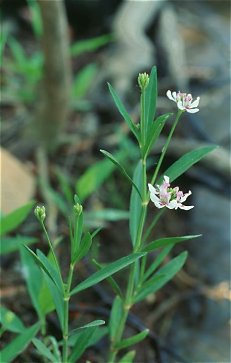
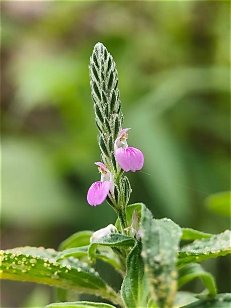
Description: Perennial to 75 cm or higher with laneolate or narrowly oblong leaves. Leaves simple, willow‑like, 8–16 cm (3–6 in) long, 8–25 mm (1/3–1 in) wide. Small white flowers with pale purple markings, in whorled clusters; prominent bee‑guiding lines. Flowers in peduncled heads, the corolla 1-1.2 m m long.
Field Identification: Emergent aquatic perennial with slender, creeping rhizomes forming large colonies (up to ~90 m²). An aquatic with bicolored flowers in dense, head-like or spike-like clusters on long slender stalks rising from leaf axils.
Plant Trivia: Named after Scottish botanist James Justice; “americana” reflects its native range.
Occurrence: Native from southern Texas through Mexico into Central America. Grows in shallow riffles of streams, rivers, lakes, and ponds, often on muddy shore. Found only in the Tivoli area of the Texas Coastal Bend and north-eastward.
Bloom Period: Apr-Oct
Plant Use: Deer browse leaves; beavers, muskrats, and nutria feed on rhizomes. Used as landscape in water gardens, pond margins, and wetland restoration. Stabilizes banks, prevents erosion. Rhizomes and roots provide spawning sites for many fish species and habitat for invertebrates. Larval host: Texas Crescent Spot Butterfly. Provides habitat for aquatic invertebrates, fish, amphibians, reptiles, and birds.
Dichotomous Key to the Genus Justica:
- Stems glabrous…………………….J. ameiciana
Stems hirsute…………………………….J. pilosella
 stxflora