Solanum americanum
Family: Solanaceae
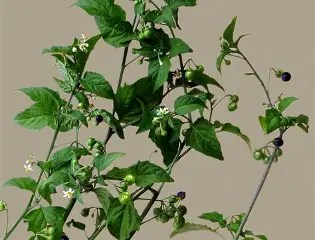
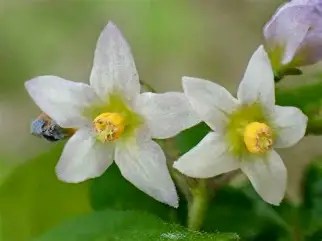
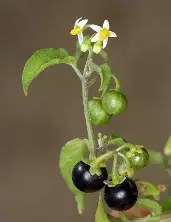
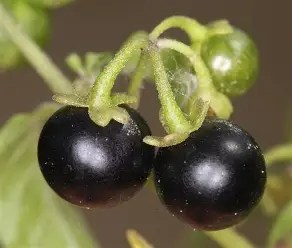
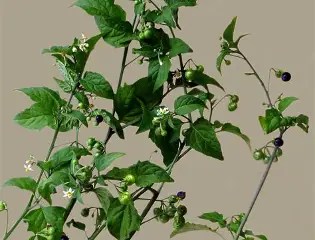
Identification: Perennial to 120 cm or higher, the stems erect t spreading. Leaves ovate, 3-6 cm long. Flowers in clusters, the corolla 5-9 mm wide, white or rarely purplish. Berries black.
Field Identification: This thinly branched nightshade, like all nightshades has downward directed flowers. The flowers on this plant are the smallest of our local nightshade species. As a reminder, if you have ever grown tomatoes, you know what nightshade flowers look like.
Erect stems are angular and widely branched, sometimes turning woody, with curved teeth as they age. Pale green alternate leaves are oval to lance-shaped, with a coarsely wavy or toothed margin. Produce star-shaped white flowers with a yellow cone-shaped center. The green fruits mature into shiny black berries, containing numerous small seeds. It has a fibrous root system and slender taproot. The stems are green and erect. The undersides of the green leaves are slightly hairy. The white star-shaped flowers and berries appear in clusters.
Plant Trivia: All parts are poisonous to humans and pets. The genus name, Solanum, is the Latin word, solamen, which means “comforting or soothing.” The species name, americanum, is Latin for “from America.” The toxin is known as solanine.
Occurrence: Frequent on various soils in pastures, woods, and waste places and around habitations. Native to North and South America.
Bloom Period: Mar-Nov, or all year.
Plant Use: It is a nectar source for small bees and wasps and flies and beetles.
Dichotomous Key to the Genus Solanum: Key to this Genus may be found in Plants of the Texas Coastal Bend by Roy L. Lehman, Ruth O’Brien, and Tammy White

