American Burnweed, Fireweed, Pilewort#American-Burnweed-Fireweed-Pilewort
Erechtites hieraclifolius
Family: Asteraceae
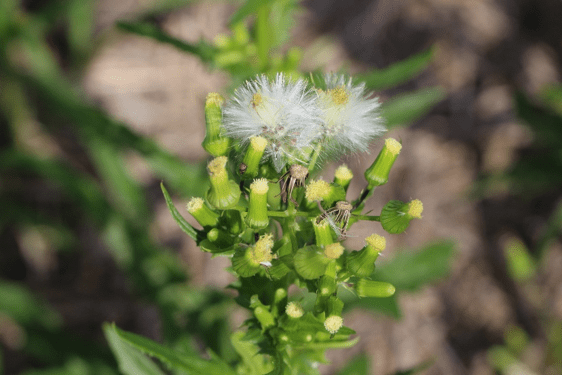
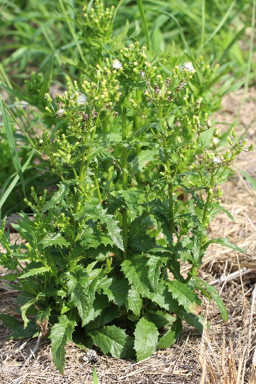
Description: An annual herb with alternate, simple leaves, on thick, rich green stems that grow to 0.4 to 3 meters or more in height. Leaves are alternate, serrated, 5-20 centimeters long, 0.5-6.5 cm wide, and range from unlobed to deeply lobed. Composite flowers (heads) in clusters at ends of upper-axillary stalks and terminating stem, about 1/4 in. wide (1/3 in. tall), cylindrical with a swollen base, consisting of numerous, densely crowded, tiny, white or dull yellow disk florets. A tube composed of erect, narrow, green bracts surrounds the head, nearly concealing the florets. Stems grooved-striate, unbranched, smooth or hairy.
Field Description: Leaves resemble leaf lettuce; most leaves are noticeably clasping. Crushed leaves sometimes are aromatic. The plant is erect, barrel shaped with thick foliage. Flowers do not open up but remain bound in the calyx until it ruptures. Airborne seeds fold out of each flower.
Plant Trivia: Grows in disturbed soil (fire, plowing, scraping) but invests only until other native plants take control then fades away after a season or two, categorizing it as a pioneer plant. Its common names allude to its growing in fire-destroyed areas. Flowers are pollinated primarily by wasps and honeybees, and seeds are wind-dispersed.
Occurrence: American native plant but introduced in other places around the world. Most common in East Texas and further east. Prefers moist soil but tolerates gravelly and sandy soils. Resistant to the herbicide imazypyr and imazypyr-glyphosphate.
Bloom Period: Spring-Fall
Plant Use: Native Americans made a tea from the plant to treat many ailments including diarrhea, cystitis, and dropsy.
 stxflora