Buchnera americana
Family: Orobanchaceae (Scrophulariaceae)
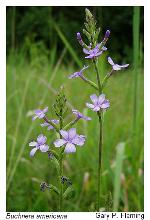
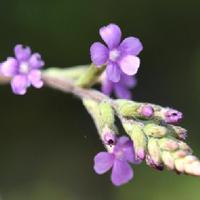
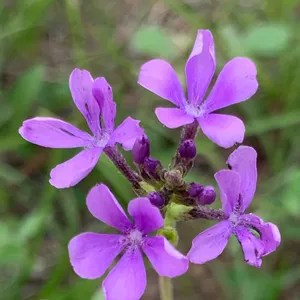
Plant Description: Perennial, herbaceous plant which grows to 60 centimeters high with thick elliptic or elliptic-linear leaves 4 -10 centimeters long, arranged opposite. Leaves often with trichomes (hair-like projections). Roots are rhizomes. Dark violet flower grows in a slender spike, corolla 10-13 mm long. Flowers are bilaterally symmetrical with five petals forming a narrow tube that opens outward at right angles.
Plant Trivia: Stems that are broken leave a black dye on the hands. Plants are partially parasitic on roots of nearby plants. They attach to their host plant by parasitic roots called haustoria (a rootlike structure that grows into or around anther structure to absorb water or nutrients). During stressful conditions (such as drought), bluehearts may heighten their parasitic effects to the point where a large group of them may damage small trees. Common host trees of bluehearts are white oak (Quercus alba), eastern white pine (Pinus strobus), green ash (Fraxinus pennsylvanica), and cottonwood (Populus deltoides). Caterpillars of the common buckeye (Junonia coenia) feed on the blueheart. Plant, named after botanist August Heinrich Buchner, is sometimes hemiparasitic, attaching to tree roots. Common host trees of bluehearts are white oak (Quercus alba), eastern white pine (Pinus strobus), green ash (Fraxinus pennsylvanica), and cottonwood (Populus deltoides). Caterpillars of the common buckeye (Junonia coenia) feed on the blueheart. Plant, named after botanist August Heinrich Buchner, is sometimes hemiparasitic, attaching to tree roots.
Field Identification: This slender, erect-stemmed plant reaches heights of 1 to 2 feet. It has narrow, lance-shaped, glabrous leaves usually arranged oppositely along the stem.
Occurrence: Occasionally found on damp or low coastal sands. Known from Aransas National Wildlife Refuge (ANWR) to Flour Bluff and Padre Island to the Rio Grande Valley; occasionally found inland in Goliad and Refugio counties. Prefers soils that are well-drained, slightly acidic to neutral (pH 6.0–7.5), with good organic matter. Drought-tolerant.
Bloom Period: Spring-Fall
Plant Use: This plant, which has no medical uses, is highly attractive to bees, butterflies, and birds and is increasingly used as a garden ornamental plant.

